Originally published December 3, 2018. Substantially updated August 26, 2026.
Growth hacking is one of the most misunderstood ideas in business. It has been reduced to marketing tricks, viral loops, A/B tests, cheap acquisition and, increasingly, AI. Those things can all play a role. But they are not the idea itself.
Growth hacking is the systematic search for disproportionate growth.
It is the search for leverage — a point where a relatively small change in input creates a materially greater change in output. Less friction for more conversion. The same customers producing more value. The same assets producing more opportunity. The same organization producing a dramatically better result.
The hack is not the objective. The leverage is. And the real value appears when that discovery can be turned into a repeatable system.
PART ONE — THE REAL IDEA BEHIND GROWTH HACKING
The growth dilemma
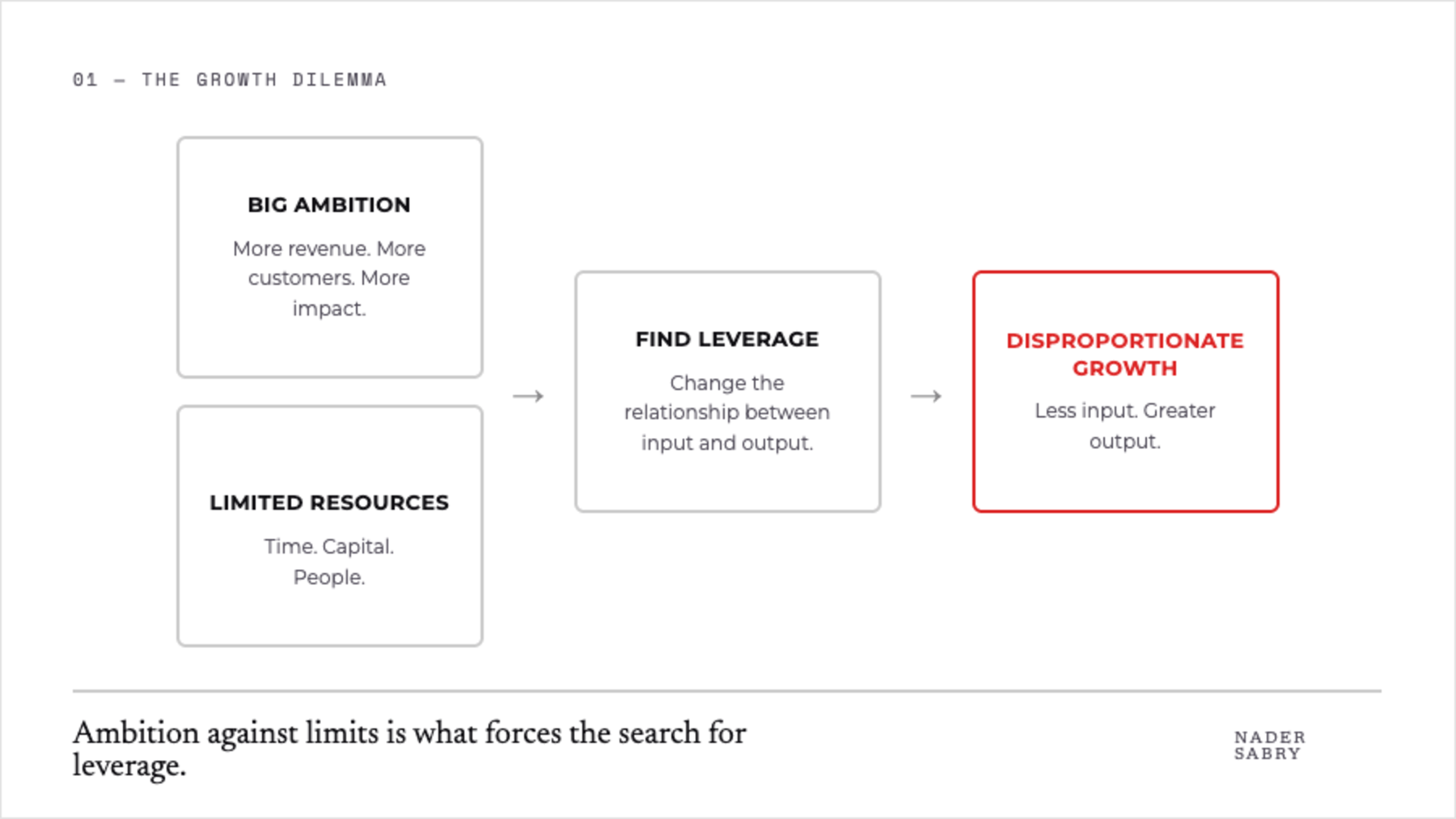
Every ambitious organization wants more: more revenue, more customers, more market share, more innovation, more impact. Yet the resources available to produce that growth are always finite.
There is only so much time, capital, talent, technology, data and organizational attention. That creates what I call the Growth Dilemma: how do we produce significantly more without simply adding significantly more?
The conventional response is linear. Need more sales? Add salespeople. Need more customers? Spend more on acquisition. Need more capacity? Add people, systems and infrastructure. Sometimes that is exactly the right answer. But it does not change the underlying economics.
Growth hacking asks a different question: where is the leverage? Where can one additional unit of effort create five, ten or even one hundred additional units of value?
From hacks to leverage
The word hack created much of the confusion. It made the discipline sound like a shortcut: a referral mechanic, a landing-page trick, a pricing move, a viral feature.
Those can be excellent growth ideas. But copying somebody else's tactic is not growth hacking. Every mechanism sits inside a specific customer, product, market, timing, economics and organization. Remove the context and the same tactic may do nothing.
The real capability is not copying hacks. It is systematically discovering what creates growth in your context.
That is also why disproportionate growth matters more than speed alone. Imagine two companies each add $2 million in revenue. One gets there by adding roughly $2 million of new cost and capacity. The other gets there through a pricing change, a retention improvement, a distribution shift or an underused asset. The headline result may look similar. The economics are completely different.
Growth hacking is interested in the second path: changing the relationship between input and output.
How the discipline evolved
Growth hacking itself has evolved. Sean Ellis introduced the term “growth hacker” in 2010, but the practice quickly widened beyond its early startup and technical roots.
I think about that evolution in three generations:
First came hacking and code — technical ingenuity used to create new pathways to growth.
Then came technology plus marketing — data, experimentation, acquisition and product behaviour working together.
Then came cross-functional growth — strategy, product, pricing, operations, partnerships, talent and technology all becoming legitimate places to look for leverage.
That third generation is the important one. Growth does not belong to a department. It is an organizational outcome. If the best opportunity sits in pricing, onboarding, partnerships or operations, a marketing-only definition will never see it.
This is also the cleanest way to understand growth hacking versus growth marketing. Growth marketing usually concentrates on the customer journey and the mechanisms that acquire, activate, retain and expand customers. Growth hacking can use all of that, but its search field is wider: it follows the growth constraint wherever it leads — into product, pricing, operations, distribution, talent or the business model itself.
Why strategy matters more than tools
Technology can accelerate growth hacking enormously. AI can generate hypotheses, analyze behaviour, personalize experiences, automate execution and shorten the time between question and evidence.
But technology still cannot answer the most important strategic question: where should we grow?
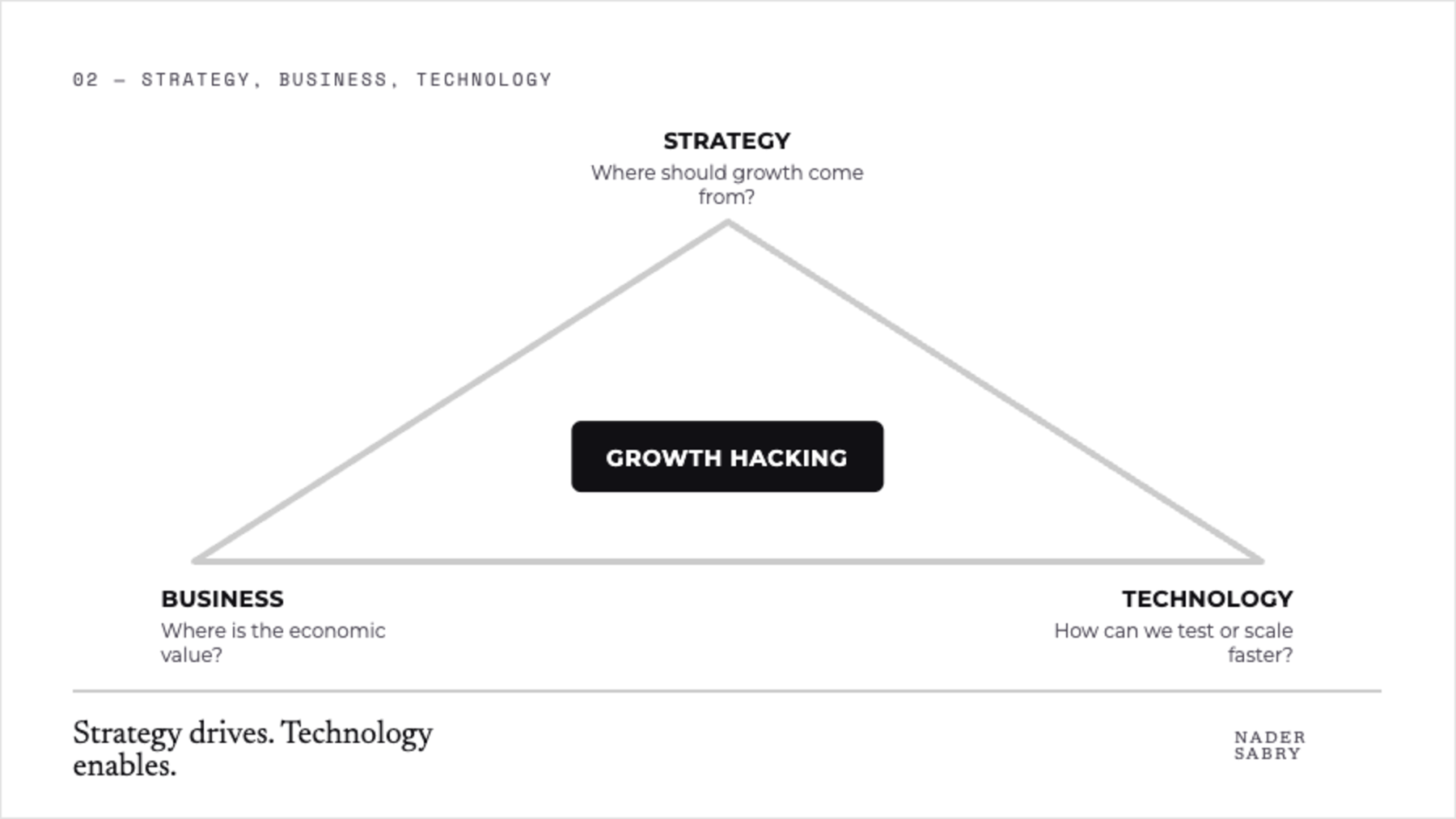
I have therefore always seen growth hacking sitting across three domains: strategy determines where growth should come from; business determines where the economic value is; technology helps us discover, test or scale it faster.
Strategy drives. Technology enables.
There is one more discipline that matters before acceleration: validation. A brilliant growth engine cannot rescue something customers do not value. Before you amplify a product, offer or business model, validate the demand, the customer, the usability, the economics and the ability to scale. Otherwise you simply accelerate the wrong thing.
Why this matters even more now
The cost of experimentation is collapsing. AI can help generate concepts, write code, analyze customer behaviour, build prototypes and produce variations in minutes. That is good news — but it also means the ability to produce more experiments is becoming less scarce.
The scarce capability is increasingly judgment: seeing the right problem, framing the right question and knowing which result is commercially meaningful.
In other words, the modern growth hacker is not simply the person who can move fastest. It is the person or team that can learn fastest about the things that matter most — and turn that learning into an advantage.
PART TWO — HOW GROWTH IS ACTUALLY DISCOVERED
Start with the opportunity
Many organizations begin growth hacking in the wrong place: with ideas. They run workshops, hackathons and brainstorming sessions, then celebrate the number of experiments produced.
That creates activity. It does not necessarily create growth.
The better sequence is to find the opportunity first. Diagnose before you ideate. Ask what is really constraining the result, where value is leaking, what customers are already telling you, and what part of the system behaves differently when outcomes are better.
A useful way to sharpen that diagnosis is to ask which type of constraint you are dealing with: demand, conversion, monetization, retention or capacity. The categories are not the answer; they simply stop you from prescribing a tactic before you understand the problem.
A discovery process, not an idea factory
Once the opportunity is clear, the work becomes a discovery process. Observation creates a question. The question creates a hypothesis. The hypothesis creates an experiment. The experiment creates evidence. Evidence creates learning. And learning should change the next decision.
Observe → Question → Hypothesize → Test → Measure → Learn → Scale
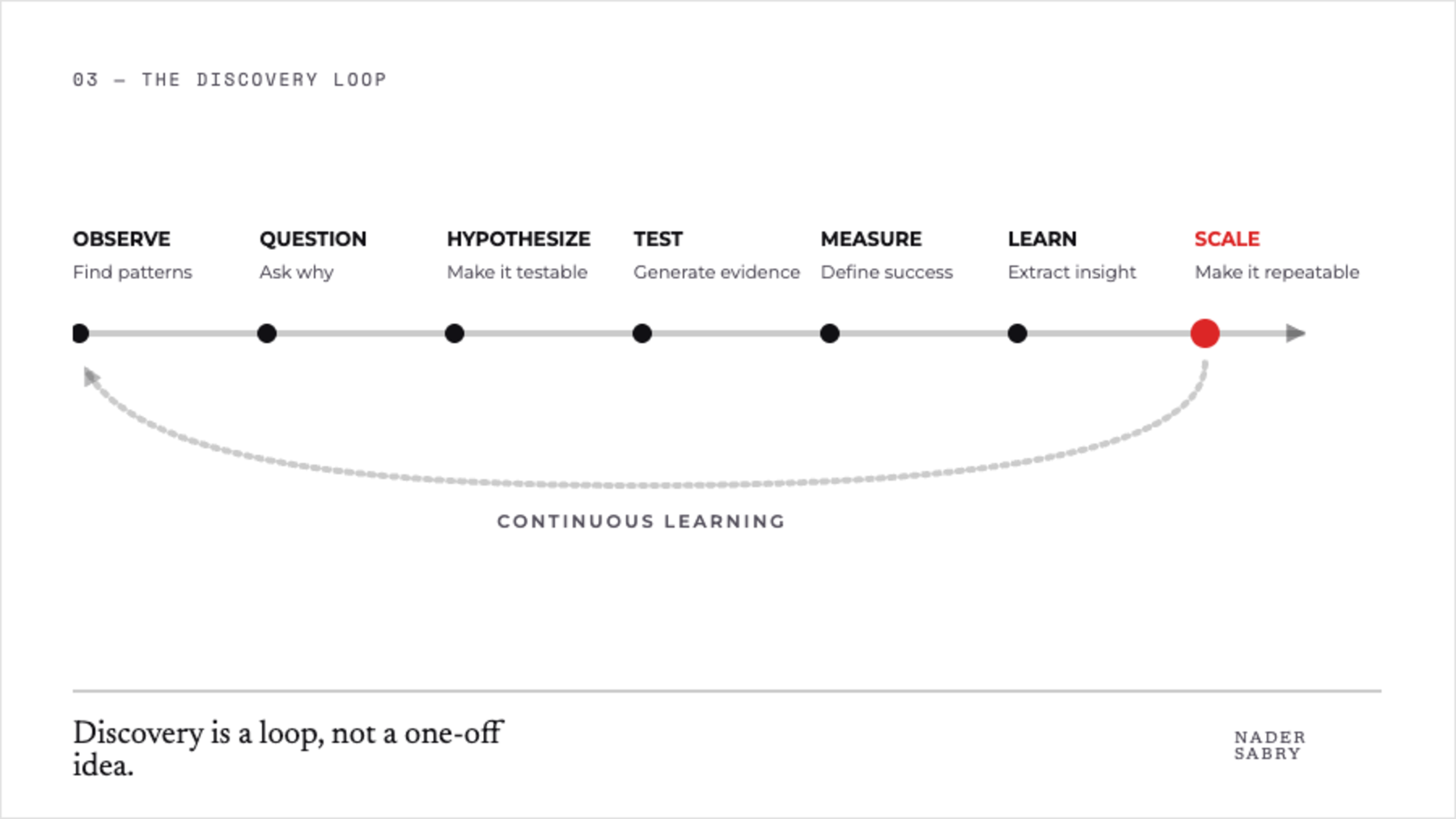
The point is not to turn this into a rigid seven-step manual. In practice the sequence is fluid. You may return to the observation, revise the hypothesis or discover that the original problem was framed incorrectly. What matters is that the organization learns rather than simply acts.
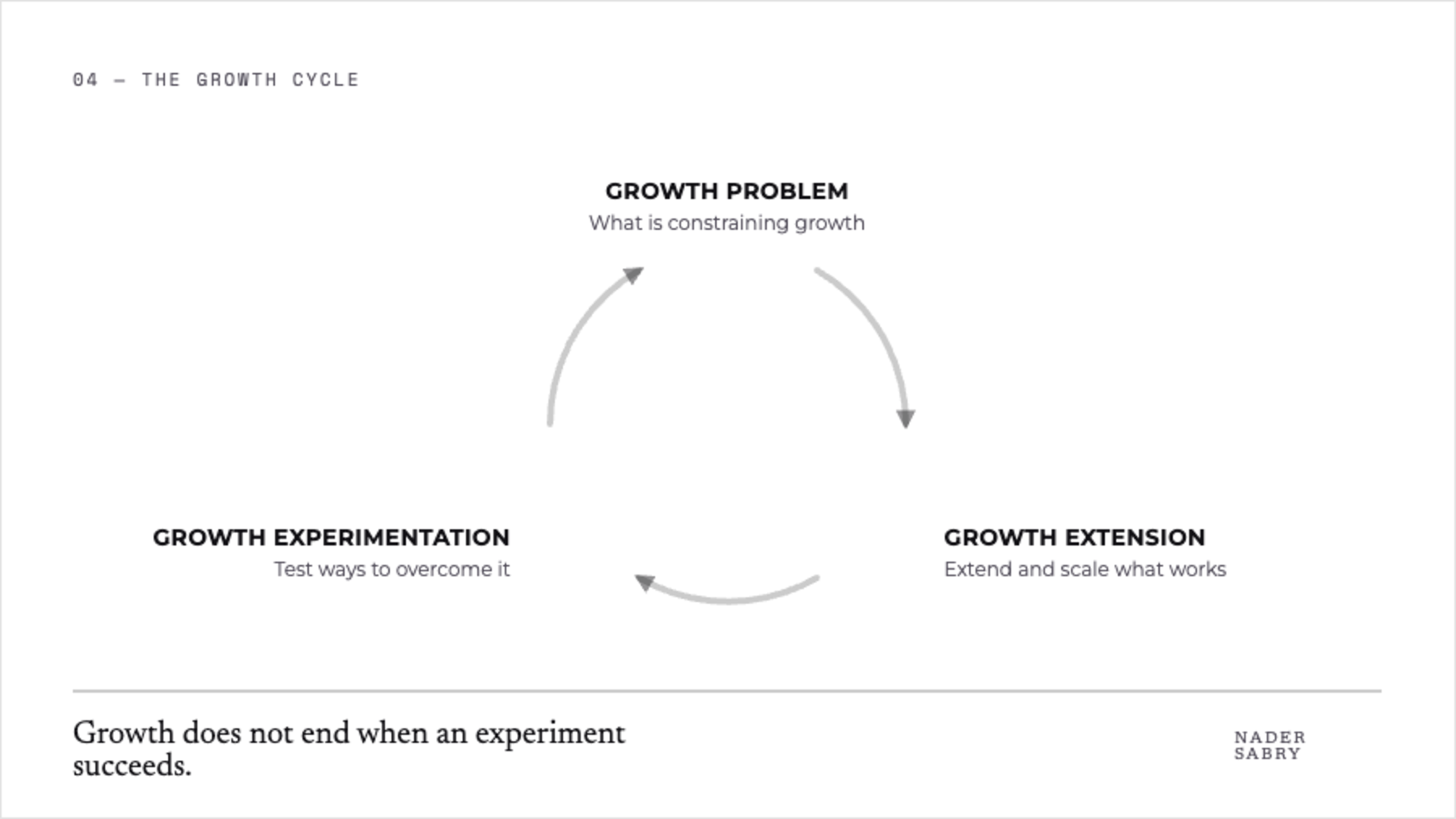
At a higher level, I use a second idea — the Growth Cycle — to describe how that learning compounds across the organization: identify the growth problem, experiment against it, then extend what works.
Discovery Loop = experiment-level learning. Growth Cycle = organization-level compounding.
Where growth hides
Because growth is an organizational outcome, the opportunity can hide almost anywhere: acquisition, conversion, pricing, product, retention, expansion, distribution, partnerships, operations or the business model itself.
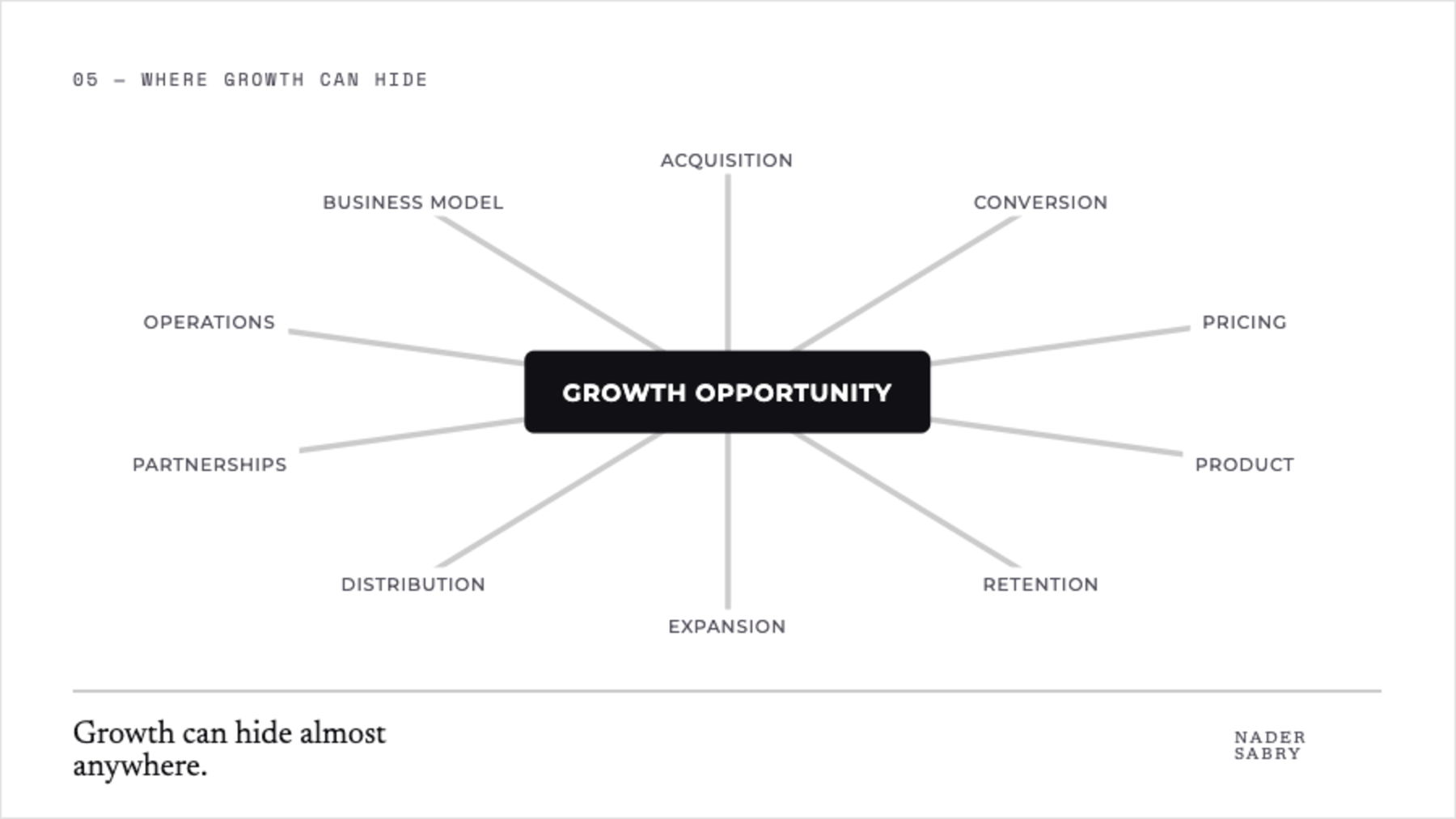
This changes the way you diagnose a business. A company that believes it has an acquisition problem may actually have an onboarding problem. A business chasing more customers may already have enough customers but be under-monetizing them. A company asking for more leads may simply be too slow to convert the demand it already has.
Consider a software company convinced it needs more marketing. Lead generation is healthy. Sales conversion is healthy. The real leak appears after the sale: a large share of new customers never complete onboarding. Fewer steps, clearer milestones and faster access to the product's highest-value feature improve activation and retention.
No additional demand was required. The growth was already inside the business.
The same principle appears in ecommerce. If customers frequently buy two products together, the next growth move may not be more traffic. It may be a better contextual add-on that increases average order value. Again, the tactic is less important than the logic: find an underleveraged point in the existing system and change its economics.
The same thing happens in B2B. A services firm may believe its problem is lead generation when the real constraint is the handoff between proposal and decision. Proposals take too long, proof is scattered, and buyers lose momentum. Shortening that decision path can unlock revenue without generating a single new lead. Again, the growth comes from changing the system, not adding more activity.
What makes an experiment worth running
Not every experiment deserves to exist. The useful ones share four qualities: they address something material, they can be tested credibly, the result can be measured, and — if successful — they have a path to scale.
That last point is where growth hacking often becomes shallow. A clever one-off win is interesting. A discovery that can become a repeatable capability is strategically valuable.
The objective is not more experimentation. The objective is better discovery.
The questions that matter are therefore not “How many tests did we run?” but “What did we learn? What uncertainty did we remove? What changed economically? What capability did we build?”
PART THREE — FROM ONE WIN TO A GROWTH SYSTEM
The system behind sustainable growth
A successful experiment is only the beginning. If the result depends on one person, one campaign, one piece of technology or one temporary circumstance, the growth is fragile.
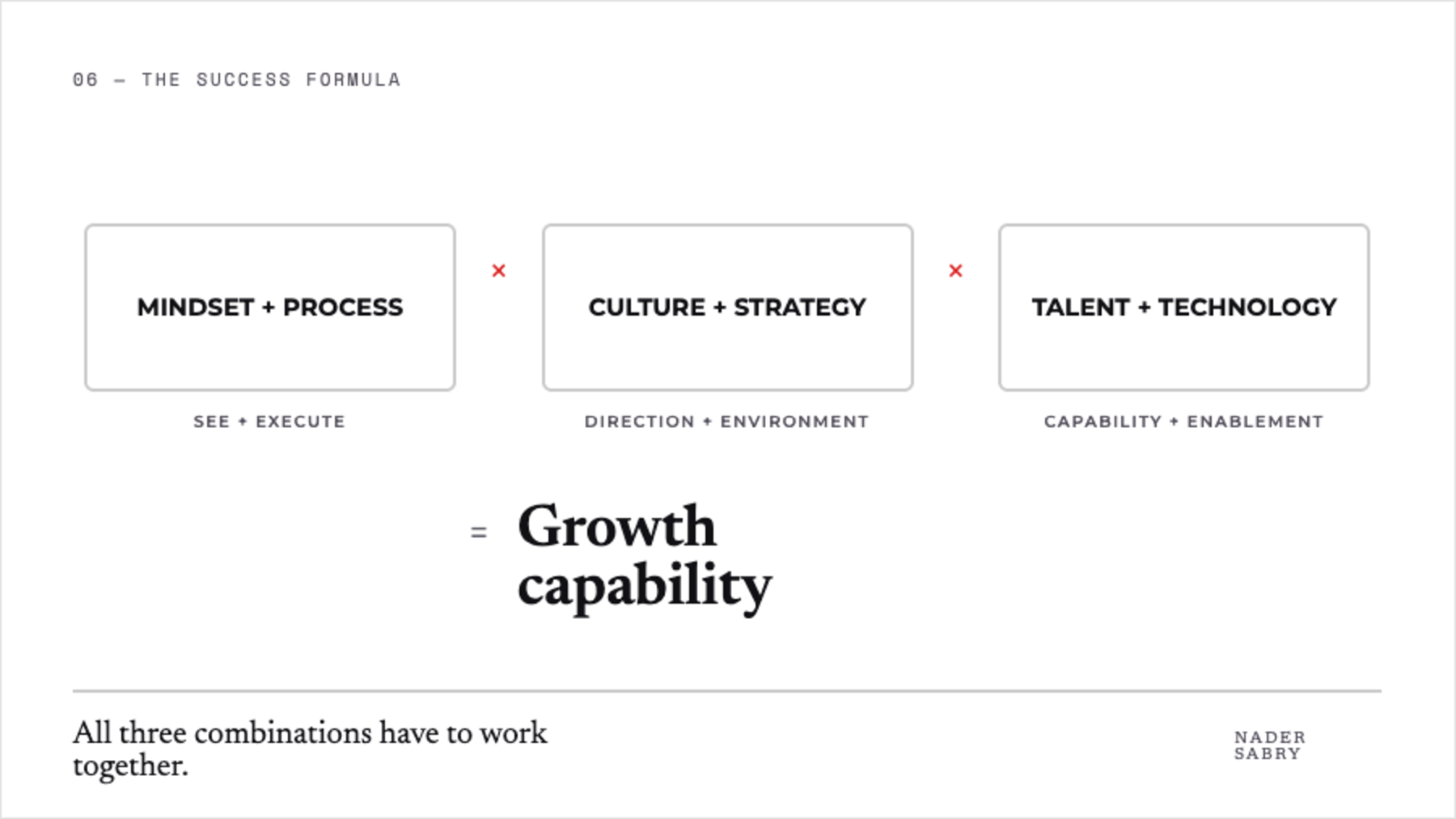
This is why I eventually framed growth hacking as a system rather than a collection of tactics. Sustainable growth requires combinations to work together:
Mindset + Process — the ability to see opportunities and a disciplined way to pursue them.
Culture + Strategy — organizational permission to act combined with clear direction.
Talent + Technology — people capable of executing combined with tools that amplify them.
I treat those relationships multiplicatively, not as a checklist. A serious weakness in one part constrains the whole system.
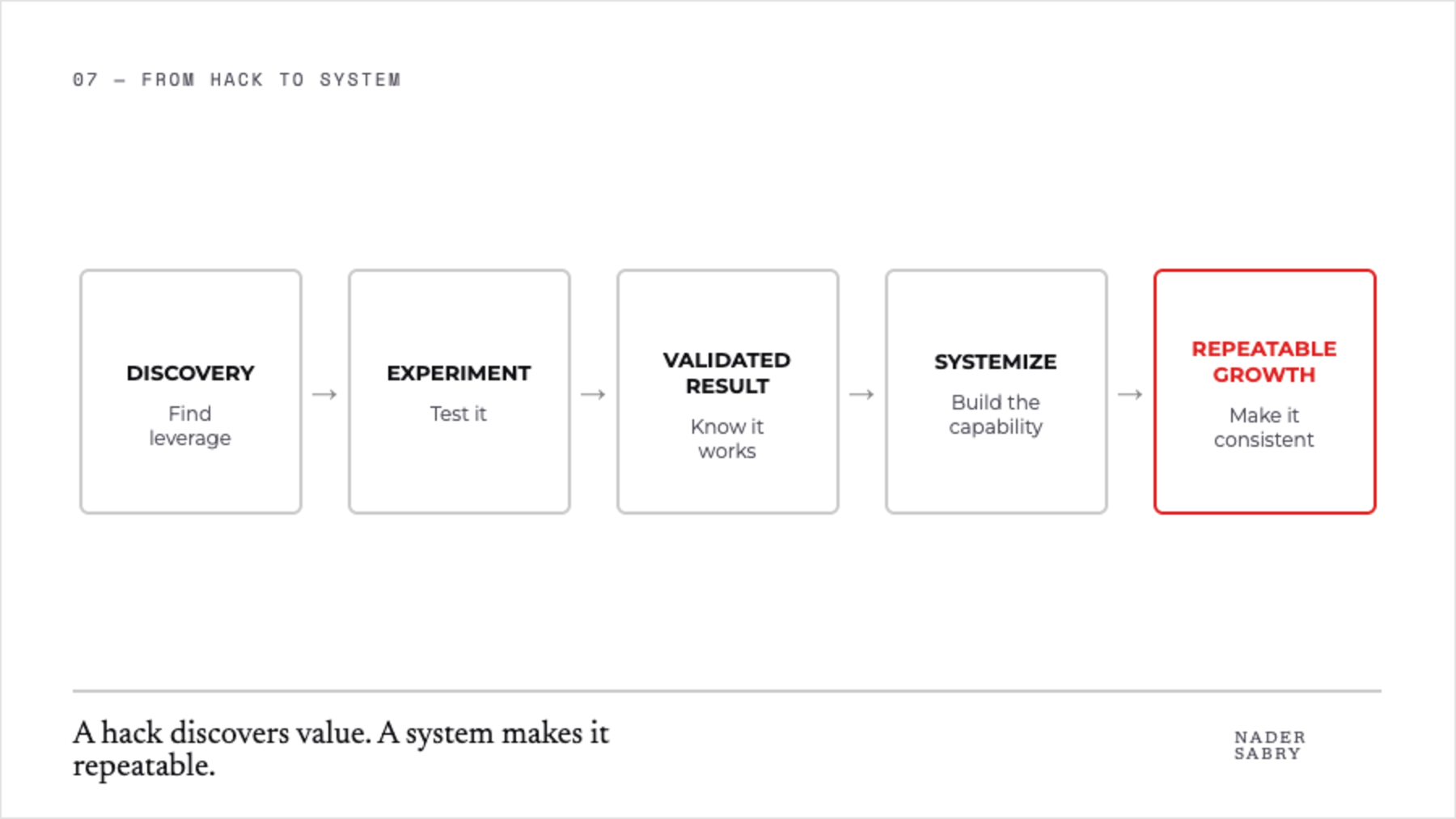
Once an experiment proves something meaningful, the next question is simple: how do we make it happen repeatedly? That may require process, technology, data, people, governance and partners. At that point the organization is no longer running a hack. It is building a capability.
And systems still need leadership. Someone must connect the parts, maintain the strategic direction, translate evidence into decisions and create the conditions for people to act. Growth becomes increasingly cross-functional as it matures, which makes leadership more important, not less.
This is where growth stops being a side project and starts becoming an operating capability. Ownership becomes clear. Measures become consistent. Successful behaviours are built into process. Teams know which decisions they can make quickly and which require governance. The organization is no longer hoping to repeat a win; it is designing for repeatability.
From Growth Hacking to Growth Thinking
Growth hacking helped answer where leverage might exist and how to test it. But another problem appeared: even a brilliant growth idea can fail between conception and execution.
That led me to Growth Thinking — a way of moving from an abstract growth idea toward something that can be visualized, designed, prototyped, improved and scaled.
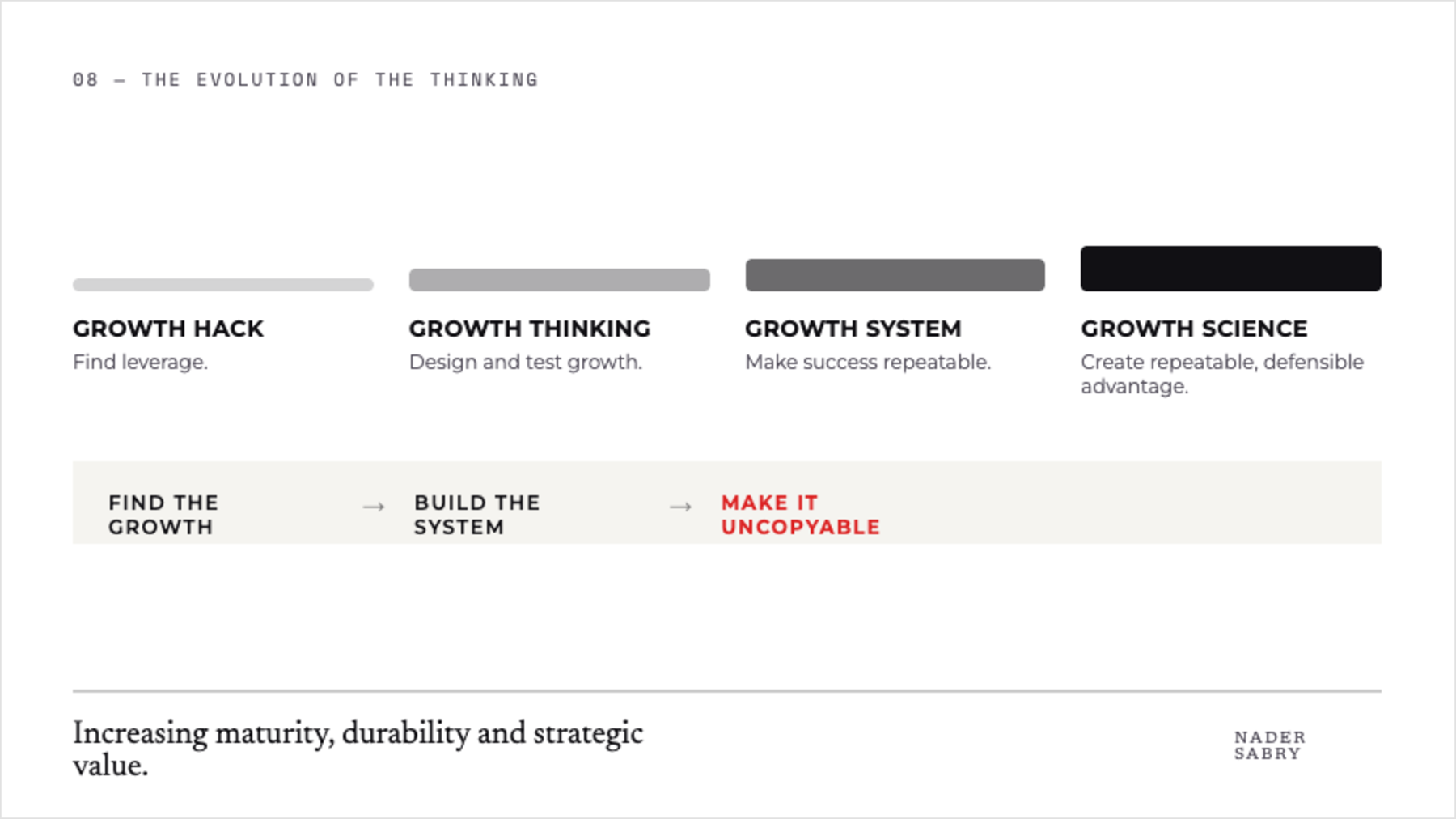
The shift is subtle but important. Growth hacking asks us to discover leverage. Growth Thinking asks us to deliberately design what happens next. Growth systems make the successful outcome repeatable.
Four books, one evolving body of work
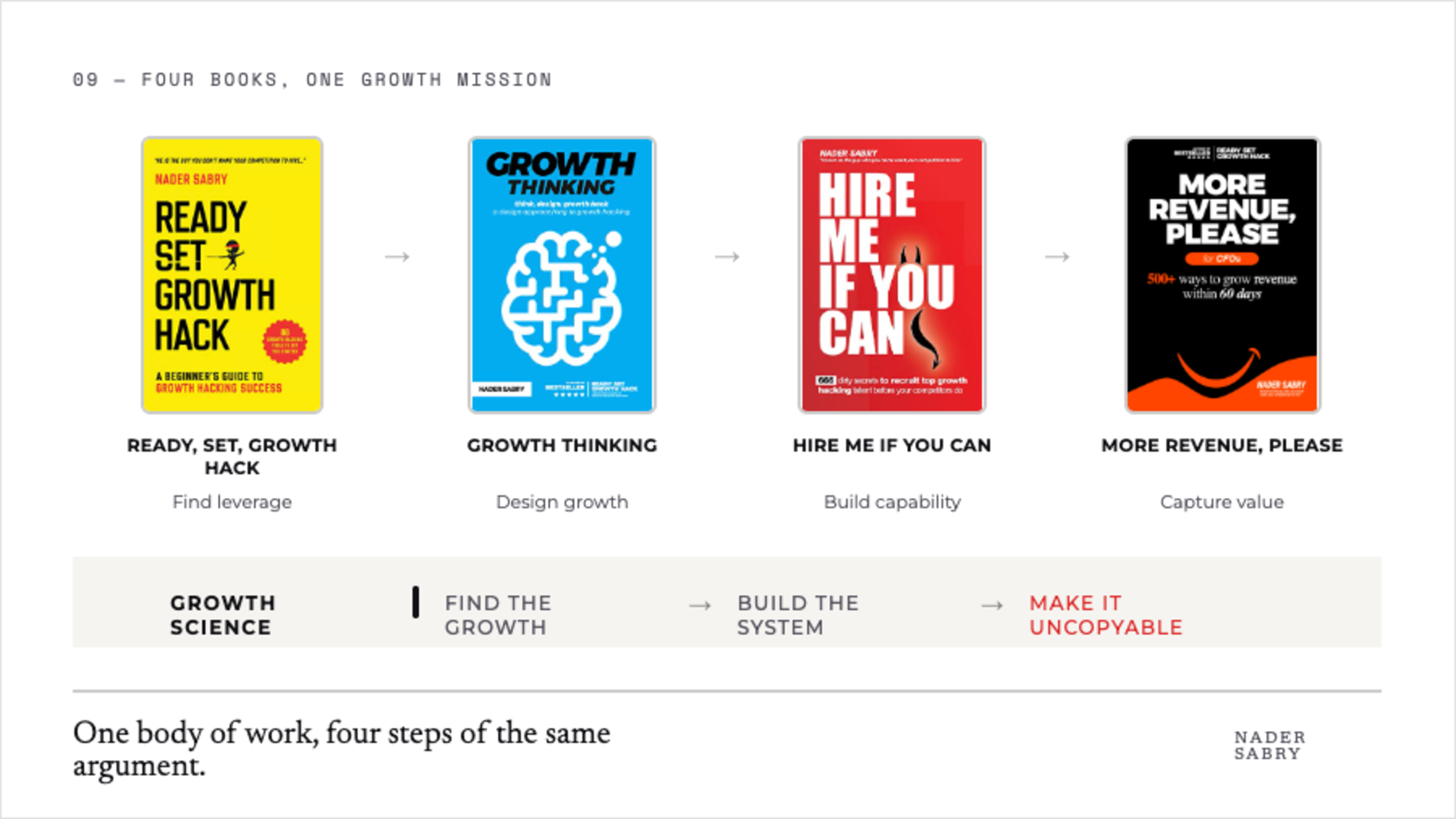
That evolution can also be seen across my four books. They were written at different moments, but they address connected layers of the same growth problem.
Ready, Set, Growth Hack explored leverage, the Growth Dilemma and the foundations of disproportionate growth. Growth Thinking focused on turning growth ideas into structured action. Hire Me If You Can looked at the human capability required to find, test and operationalize growth. More Revenue, Please brought the thinking directly into commercial execution: finding, unlocking and protecting value that may already exist inside the business.
Together they move from finding leverage, to designing growth, to building capability, to capturing economic value.
Ready, Set, Growth Hack: https://www.nadersabry.com/books/ready-set-growth-hack
Growth Thinking: https://www.nadersabry.com/books/growth-thinking
Hire Me If You Can: https://www.nadersabry.com/books/hire-me-if-you-can
More Revenue, Please: https://www.nadersabry.com/books/more-revenue-please
What growth hacking means now
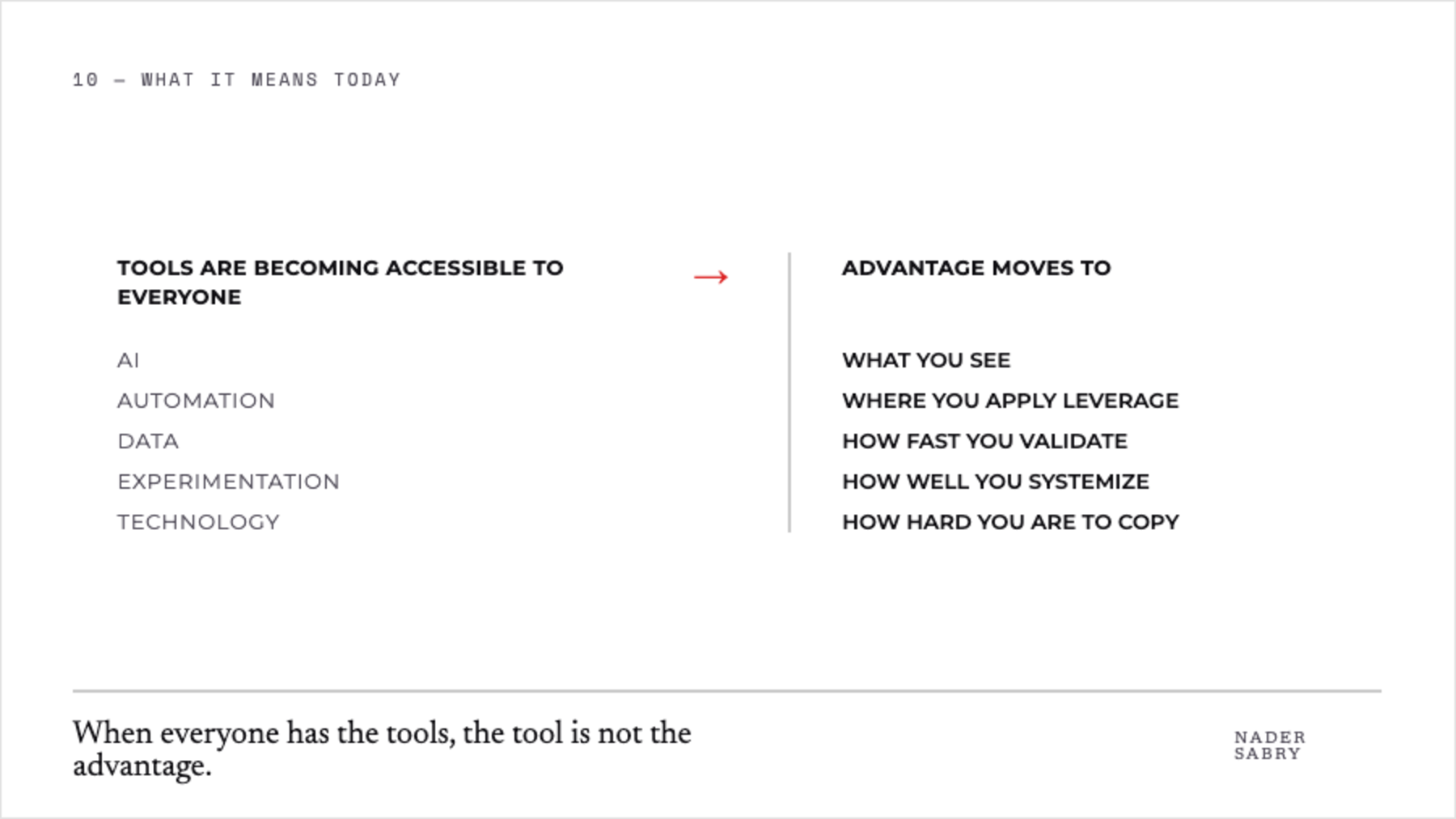
The environment around growth hacking has changed dramatically. AI, automation, analytics and experimentation tools have made many capabilities cheaper, faster and more accessible.
That should make growth easier. In one sense it does. But it also removes an old source of advantage.
When everyone has the tools, the tool is not the advantage.
The differentiator shifts toward what you see that others do not, where you apply leverage, how quickly you validate it, how well you systemize what works and how difficult the resulting capability is to copy.
Where the thinking went next
This is where growth hacking becomes part of a larger discipline.
Growth hacking taught us to search for leverage. Growth Thinking helped turn the opportunity into something designed and testable. Growth systems made success repeatable. The next question is whether the organization can repeatedly find growth, build the system that captures it and create an advantage that competitors cannot easily reproduce.
That is the direction of Growth Science: Find the Growth → Build the System → Make It Uncopyable.
I will develop Growth Science as its own dedicated body of work. For now, the important point is that growth hacking was never really about collecting clever hacks. It was an early step toward treating growth as a discipline that can be observed, designed, tested, systemized and defended.
Continue the evolution: https://www.nadersabry.com/about
A final thought
If you want to start growth hacking, do not begin with a list of tactics. Begin with one meaningful growth objective and one honest question: what is actually preventing this result?
Look for the constraint. Look for the underused opportunity. Look for value that already exists but is trapped, ignored or poorly monetized. Form one clear hypothesis. Run the smallest credible test. Learn from the evidence.
The point is not to make growth complicated. It is to stop treating growth as luck, a marketing campaign or an endless stream of ideas. Growth becomes much more manageable when you can see the problem clearly, search deliberately for leverage, and build what works into the business.
Find the leverage. Test it. Build the system. Turn it into an advantage.