
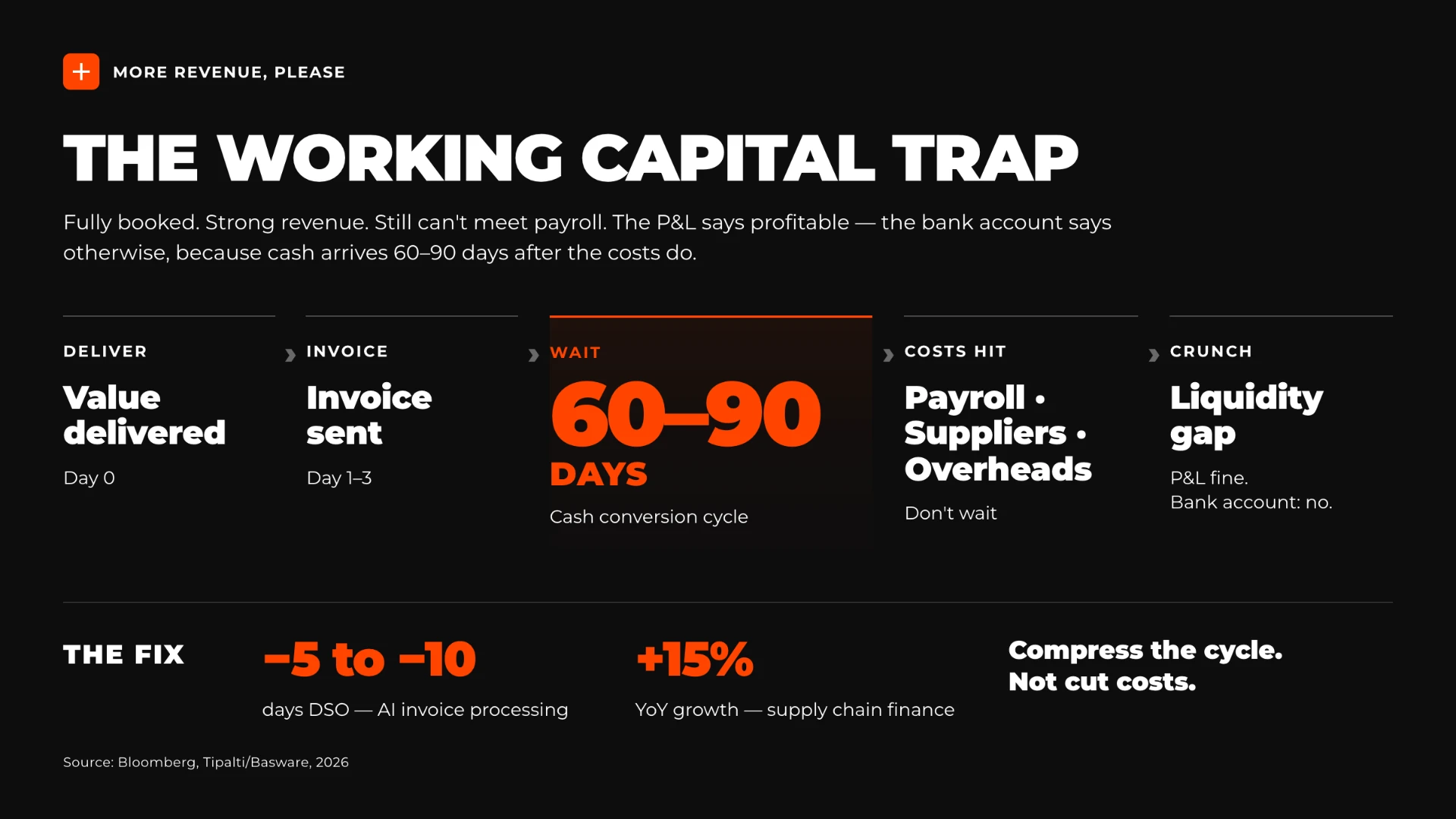
Revenue is earned the day the deal closes. Cash arrives weeks — sometimes months — later.
The timing gap between earning and receiving is the working capital trap.
Every founder who has made a decision under cash pressure their P&L said they didn't need knows this feeling.
The Gap Nobody Talks About
Profitability is an accounting concept. Cash is a physical reality. A business can be profitable on paper and simultaneously unable to make payroll.
This happens because revenue recognition and cash collection are rarely the same event. You deliver the product. You issue the invoice. Net-30 becomes Net-45. Net-45 becomes Net-60. Somewhere between delivery and deposit, the business stalls.
Construction companies feel this acutely. Manufacturers feel it. SaaS companies feel it at scale when enterprise contracts close in Q4 but cash lands in Q2. Professional service firms feel it every time a retainer client pays late.
The trap doesn't care how good the business is. It is a structural problem built into how commerce operates: suppliers get paid before customers pay. The business sits in the middle, absorbing the gap.
The Data
55% of small businesses cite cash flow constraints as their primary growth barrier — not competition, not talent, not market demand. Cash. (Fora Financial, 2026)
In construction alone, 90% of contractors report working capital as a persistent operational problem. (For Construction Pros, 2026)
The scale of the problem is measured in hundreds of billions. C2FO has unlocked over $445 billion in working capital across its network. Taulia has processed over $250 billion across 1 million suppliers, freeing more than $35 billion in cash that was sitting idle inside financing chains.
Revenue-based financing alone is projected to reach $42.4 billion by 2027 — a 61.8% CAGR. That growth is not speculative. It is the market pricing the cost of the working capital gap.
The embedded finance market — financial products built directly into business platforms — will reach $51 billion by 2026 according to Bain. This is not a technology trend. It is a structural shift in how working capital moves.
The Working Capital Chain — 8 Phases, 47 Companies Solving Each Problem
Working capital is not one problem. It is a chain of eight distinct friction points. Each phase has its own bottleneck. Each bottleneck now has dedicated technology companies attacking it.
Understanding the chain lets you see which phase is bleeding your business — and which tools exist to stop it.
Phase 1 — Purchase Order Financing (Before Inventory Arrives)
The problem: You win the order. You need inventory or materials to fulfil it. The supplier wants payment. The customer hasn't paid yet. You are cash-negative before the work begins.
Finkargo — Latin America-focused PO and import financing for SMEs. Funds inventory before it ships. Serves importers who previously had no access to institutional credit.
Myos — E-commerce inventory financing based on product data, not credit scores. Lends against actual goods, not promises. Particularly strong for Amazon and Shopify sellers.
Onramp Funds — E-commerce working capital using real-time platform sales data from Amazon, Shopify, Walmart. Funding decisions in hours, not weeks.
Mintifi — India-based supply chain financing connecting brands with their distributor networks. Turns distributor credit risk into a solvable financing problem.
Phase 2 — Inventory Financing (While Goods Are In Transit or In Stock)
The problem: Goods are moving or sitting in a warehouse. Capital is locked in physical inventory that hasn't converted to revenue yet.
Wayflyer — Revenue-based financing for e-commerce brands. Funds inventory, marketing, and operational costs against future sales data. Works across Shopify, WooCommerce, and major marketplaces.
Clearco — Capital for e-commerce and SaaS companies based on revenue share. No equity dilution. Specialises in funding growth cycles — inventory buys, paid acquisition, fulfilment costs.
Outfund — Revenue-based financing for online businesses across UK, EU, and Australia. Funds inventory and marketing without requiring personal guarantees.
Bloom — UK invoice and inventory finance for SMEs. Flexible drawdown facilities backed by assets rather than credit history alone.
Phase 3 — Invoice Financing (After Delivery, Before Payment)
The problem: Invoice issued. Work completed. Payment not due for 30, 60, or 90 days. Cash need is now.
FundThrough — Instant invoice funding for North American SMEs. Connects directly to accounting platforms. Funds invoices in 24 hours with no long-term contracts.
Fundbox — Lines of credit and invoice financing for US small businesses. Uses accounting data to underwrite in real time. No collateral required.
Resolve — B2B buy-now-pay-later for net terms. Resolve pays the seller immediately and extends payment terms to the buyer. Removes the credit risk from the seller entirely.
eCapital — Invoice factoring and freight financing. Particularly strong in transportation and staffing — two sectors with consistently long payment cycles.
TriumphPay — Payment and factoring network specifically for freight and logistics. Over $100B in invoices processed annually across the freight sector.
CredAble — India-based working capital platform using invoice data and supply chain signals to extend credit to SMEs within large enterprise supply chains.
Vayana — Supply chain financing network in India connecting buyers, suppliers, and lenders. Processes high transaction volumes across manufacturing and retail supply chains.
Phase 4 — Dynamic Discounting (Capturing Early Payment Revenue)
The problem: You have cash. Your suppliers need cash earlier. You are leaving a negotiated discount on the table every day you wait to pay.
C2FO — The world's largest working capital marketplace. $445B+ unlocked. Connects buyers with surplus cash to suppliers who want early payment at a discount. Both sides win.
Taulia — $250B+ processed, 1M+ suppliers, $35B freed. SAP-owned. Integrates directly into enterprise ERP systems. Dynamic discounting and supply chain financing in one platform.
PrimeRevenue — Supply chain finance platform with $500B+ in transactions. Enables large buyers to offer early payment to their entire supplier network simultaneously.
TreviPay — B2B payments and trade credit. Extends net-terms to buyers while paying suppliers on time. Removes the working capital burden from both sides of the transaction.
Phase 5 — Revenue-Based Financing (Against Recurring Revenue Streams)
The problem: You have predictable recurring revenue — SaaS ARR, subscription contracts, franchise royalties — but the bank treats it as invisible because it isn't physical collateral.
Pipe — Turns annual contracts and recurring revenue into upfront capital. Pioneered the "revenue trading" model for SaaS companies. Capital advanced against contracted ARR without equity dilution.
Capchase — Non-dilutive financing for SaaS companies against annual recurring revenue. Advances 12 months of ARR upfront. Used by over 2,500 companies globally.
Lighter Capital — Revenue-based financing for software companies. No equity, no warrants, no board seats. Repaid as a percentage of monthly revenue.
ViceVersa — Revenue-based financing for e-commerce and subscription businesses in Europe. Uses real-time sales data to deploy capital quickly.
Phase 6 — Embedded Finance (Capital Built Into the Platforms You Already Use)
The problem: Applying for working capital through a bank requires documentation, waiting, and rejection risk. Embedded finance removes the application — your platform already knows everything it needs to lend.
Shopify Capital — Cash advances and loans for Shopify merchants using real store data. Repaid automatically as a percentage of daily sales. No separate application, no credit check beyond platform history.
Stripe Capital — Working capital for Stripe users based on payment processing history. Funds appear in the Stripe account the next business day. Repayment tied to Stripe transactions.
PayPal Working Capital — Business loans for PayPal merchants based on PayPal sales history. Fixed fee, not interest rate. Repaid as a percentage of daily PayPal sales.
Square / Block — Instant capital for Square merchants. Uses point-of-sale and processing data. Repayment matches daily sales volume — slower sales, slower repayment.
Amazon Lending — Invitation-only financing for Amazon sellers. Funded directly against Amazon sales data. Capital is instantly available and repaid through Amazon settlement.
Brex — Corporate cards and cash management for high-growth companies. Credit limits based on cash balance and investor backing rather than personal credit. Now offering treasury management and bill pay.
SeQura — Buy-now-pay-later for B2B buyers embedded into merchant checkout flows. Removes friction at the point of purchase while the seller gets paid immediately.
Phase 7 — AI-Powered Cash Flow Intelligence (Predict Before the Gap Opens)
The problem: By the time the gap is visible on a bank statement, the damage is already done. AI-powered tools predict cash position days or weeks ahead — giving businesses time to act before the crisis.
Tesorio — AI-powered cash flow forecasting and AR automation for mid-market and enterprise companies. Integrates with ERP systems. Reduces days sales outstanding and improves collection rates.
Abacum — FP&A and cash flow planning platform for scale-up companies. Integrates with Salesforce, NetSuite, and HubSpot. Makes finance teams faster without adding headcount.
Versapay — Collaborative AR automation. Connects finance teams with customers directly in the AR workflow — reducing disputes, accelerating approvals, and shortening collection cycles.
Kolleno — AR management and credit control with AI-prioritised chasing. Automates follow-ups, segments customers by risk, and reduces DSO without manual effort.
HighRadius — Enterprise-grade autonomous finance platform covering AR, treasury, and record-to-report. AI models trained on billions of transactions. Used by Fortune 500 companies.
Previse — AI-based instant payment technology for B2B supply chains. Analyses invoice data in milliseconds to enable instant payment decisions — removing the 30–90 day wait entirely.
Float — Cash flow forecasting for SMEs integrated with Xero, QuickBooks, and FreeAgent. Scenario planning built in. Designed for business owners, not finance teams.
Prophix — Financial planning, budgeting, and cash forecasting for mid-market companies. AI-assisted scenario modelling and what-if analysis to stress-test working capital positions.
Phase 8 — Open Banking and Data Infrastructure (The Engine Underneath It All)
The problem: Every financing decision in Phases 1–7 depends on data quality. Open banking infrastructure connects financial data in real time — enabling faster, smarter lending decisions across the entire chain.
Plaid — Financial data network connecting apps to bank accounts in real time. Powers thousands of fintech products. The infrastructure layer that makes real-time lending decisions possible.
Codat — Business financial data API. Connects to accounting platforms, commerce systems, and banking data. Used by lenders to make faster, more accurate credit decisions.
Railz — Financial data API and analytics for banks and lenders. Normalises accounting data across Xero, QuickBooks, and FreshBooks to enable real-time underwriting.
MX Technologies — Financial data and analytics platform used by banks and credit unions. Helps financial institutions offer better working capital products using enriched transaction data.
Five Technologies Reshaping Working Capital Access
1. AI-Powered Cash Flow Forecasting
Traditional cash flow forecasting is manual, backward-looking, and wrong 25–35% of the time. AI forecasting models, trained on millions of transactions, are reaching 95% accuracy. (Tesorio, 2026)
The shift matters because a business that can see its cash position 30 days ahead has time to act. A business that discovers the gap on the day payroll is due does not.
Where this is going: AI models will move from forecasting to prescribing. They will not just tell you the gap is coming — they will automatically trigger the right financing product to close it, without a human decision in the loop.
2. Revenue-Based Financing Algorithms
The traditional credit model values collateral and credit history. Revenue-based financing algorithms value predictability of future cash flows. This unlocks capital for businesses that banks cannot lend to — not because they are risky, but because they don't fit the traditional model.
Platforms like Pipe, Capchase, and Clearco are using machine learning to underwrite revenue streams in hours. What took a bank six weeks now takes a platform six minutes.
Where this is going: Granularity will increase. Financing will be offered against individual contracts, specific customer cohorts, and even single invoices — not the business as a whole. Capital becomes surgical.
3. Embedded Finance APIs
Embedded finance means financial products are no longer separate from the platforms businesses already use. Capital shows up inside Shopify, Stripe, Amazon, and QuickBooks — not through a separate bank application.
For business owners, the user experience is the same as any other platform feature. For lenders, the data advantage is enormous: they can see exactly how the business is performing before making a credit decision.
Where this is going: Every major B2B software platform will embed financing within five years. ERP systems, procurement platforms, and logistics software will offer working capital as a feature, not a separate product.
4. Open Banking Data Infrastructure
Open banking connects financial data across institutions in real time. For working capital, this means a lender can see a business's full financial picture — not just what one bank holds — and make faster, more accurate decisions.
Codat, Plaid, and Railz are the infrastructure layer. They are not visible to end users. But they are why a fintech can approve a loan in 24 hours that a bank would take 24 days to review.
Where this is going: Open finance will expand beyond banking into payroll, commerce, and supply chain data. The full picture of a business's financial health will be available in real time to any authorised party.
5. Supply Chain Finance Networks
Supply chain finance turns the buyer's credit rating into a lending tool for the entire supplier network. A large buyer with strong credit can offer early payment to thousands of suppliers who would otherwise pay 15–25% to access capital.
C2FO's $445B+ and Taulia's $250B+ in processed transactions prove the scale. This is not a niche solution. It is becoming the standard for how large enterprises manage their supplier relationships.
Where this is going: AI will automate the matching of buyers with surplus cash to suppliers with urgent need — in milliseconds, at scale, 24/7. The working capital market will trade dynamically, like a financial exchange.
Five Moves to Close the Gap — With and Without Technology
Technology accelerates every one of these moves. But the underlying principle works without it. Start with the principle. Add technology when you're ready to scale it.
Move 1 — Compress Payment Terms
Without technology: Call your top 5 customers and request a shift from Net-60 to Net-30. Offer a 1–2% early payment discount. Most accounts payable teams will take it — it reduces their workload and captures a discount. One conversation can unlock six figures of trapped cash.
With technology: Use a dynamic discounting platform like C2FO or Taulia to make early payment available to your entire customer base simultaneously. Automated, scalable, and tracked. What took manual negotiation now runs on a platform.
Move 2 — Fund Invoices Instead of Waiting
Without technology: Contact an invoice factoring firm directly. Bring your three largest outstanding invoices. Most factors will advance 80–90% of the invoice value within 48 hours. The cost is 1–3% of the invoice. Compare that to the cost of a cash shortage.
With technology: Use FundThrough or Fundbox to connect your accounting platform and get invoices funded in 24 hours without leaving your desk. The entire process is digital and repeatable.
Move 3 — Switch to Upfront Billing
Without technology: Restructure your service contracts to require 50% upfront on signature and 50% on delivery. This requires one revision to your standard contract template. For annual contracts, require annual payment in advance. Most enterprise customers will agree if you offer a small discount.
With technology: Platforms like Pipe and Capchase will advance 12 months of annual recurring revenue upfront — even before your customers pay. You collect cash now. Your customer pays on their normal schedule. The platform bridges the gap.
Move 4 — Build a Minimum Cash Reserve
Without technology: Open a separate bank account and transfer a fixed percentage — 5–10% — of every customer payment into it. Do not use this account for operations. Build until the reserve covers 30 days of fixed costs. This is not sophisticated. It is the most reliable buffer any business can have.
With technology: Use Float to forecast exactly when your cash position will hit a floor. Set automated alerts. Use Brex to hold operating reserves in a high-yield treasury account while keeping them instantly accessible.
Move 5 — Use Your Platform's Embedded Capital
Without technology: If you sell through any major platform — Amazon, Shopify, Stripe, Square — log in and check whether a financing offer exists. These platforms generate offers based on your transaction history. Most business owners never check. A meaningful percentage have pre-approved capital sitting unclaimed.
With technology: The platform IS the technology. Shopify Capital, Stripe Capital, Amazon Lending, and Square all use live sales data to extend capital in hours. No separate application. No credit score check beyond your platform performance.
The Gap Is Solvable
Working capital is not a permanent condition. It is a structural problem with structural solutions.
The financing chain is now mapped. Forty-seven companies are actively solving each phase of it — from the moment a purchase order lands to the moment cash settles. Five technologies are compressing the timeline from months to hours. Five moves can be executed starting this week, with or without technology.
The question is not whether solutions exist. The question is whether your business has connected to them.
Cash is not the reward at the end of good business. It is the fuel. Protect the fuel.
More Revenue Please
Working capital is one lever. There are 99 more — ways to create revenue, unlock it, accelerate it, expand it, and protect it from leaking out.
More Revenue Please by Nader Sabry covers all 100. Practical. Direct. Built for CFOs and founders who need results, not theory.