And Build the Board Case to Fix It. Most finance leaders know something is wrong. Very few can put a number on it.
There's a moment every CFO knows.
You're sitting in front of the board. Revenue is flat — or slightly down — and the room wants an answer. Not a narrative. Not a slide with four circles. A number.
How much are we losing? Where is it coming from? What will it cost us if we don't fix it?
Most finance leaders can't answer that precisely. They have intuitions, directional data, maybe a segment that's underperforming. But they don't have a clean, defensible number — the kind you can put on page one of a board pack and back up with arithmetic. That's not a data problem. It's a framing problem.
The Revenue Gap Is Real — But It Goes Unmeasured
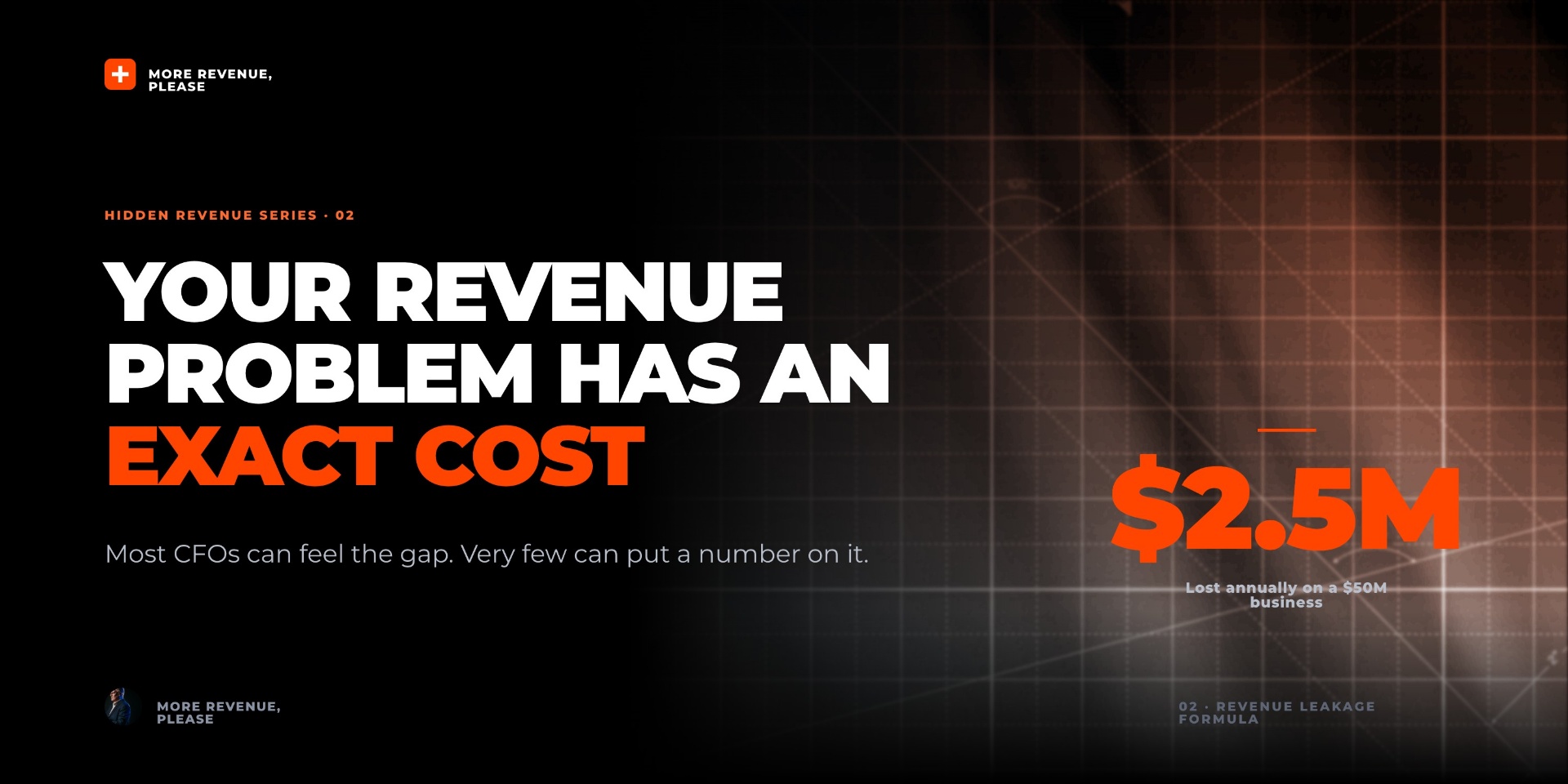
EY research shows that revenue leakage in a typical business runs at 1–5% of EBITDA annually. For a $50 million business, that's up to $2.5 million disappearing every year. Not stolen. Not written off. Just quietly lost to a combination of pricing gaps, missed upsell opportunities, slow billing cycles, unmanaged churn, and undermonetised assets.
Gartner's latest survey confirms that slower top-line growth is the single biggest challenge CFOs expect to face — ahead of cost pressures, talent issues, and strategic alignment gaps.
Yet in most businesses, this leakage has no formal measurement. It doesn't appear on the P&L with a label. It lives in the gap between what revenue could be and what it actually is — and that gap is rarely calculated with enough precision to act on.
Why Intuition Isn't Enough for the Board
The problem with intuition-based revenue diagnoses is that they produce intuition-based solutions. When leadership can't quantify the gap, the default response is almost always the same: hire more salespeople, push into a new market, or launch something new.
These are expensive, slow interventions — with payback cycles measured in quarters or years. And they address the wrong problem. If the root cause is pricing erosion, billing friction, or customer churn, more salespeople won't fix it. They'll mask it temporarily while the underlying leak continues.
A board that can't see the cost of the revenue problem clearly will always default to the action they understand best: sell more. A board that can see the number will make better decisions.
The job of the CFO is to produce that number.
What a Proper Revenue Gap Diagnosis Looks Like
Calculating the cost of your revenue problem requires answering three questions in sequence:
What does the gap look like?
Establishing a baseline — what revenue would look like at full commercial performance across every dimension the business operates in. Not a stretch target. A structured view of what the business is realistically leaving on the table.
What is driving the gap?
Revenue underperformance has distinct causes, and they respond to different interventions. Pricing compression is not the same as slow billing cycles. Customer churn is not the same as missed cross-sell. Mixing them together produces a muddled diagnosis that points to no specific action.
What is the cost of inaction?
This is the number the board actually needs. Not the revenue you're losing right now — but the compounding cost of not fixing it over the next 12, 24, and 36 months. Revenue problems that go unaddressed don't stay flat. They compound in the wrong direction.
The output of this diagnosis isn't a strategy deck. It's a one-page number: the cost of your revenue problem, attributed to specific causes, with a defensible methodology behind it.
The Arithmetic Is the Point
When you can show a board that $1.8 million in annual revenue is being lost across three specific causes — each attributable, each fixable, each with a measurable intervention — you've changed the conversation entirely.
You're no longer asking for permission to try something. You're presenting a business case with a quantified return, a time frame, and a clear priority order.
That's what separates finance leaders who drive commercial decisions from those who report on them after the fact. The diagnosis comes first. The methodology to get there is what most businesses are missing.
More Revenue, Please — 500+ Ways to Grow Revenue Within 60 Days is available now in paperback and hardcover.
Nader Sabry is a growth scientist, HBR Arabia contributor, and author of the Growth Science series.