Customers are still buying. Your margin is shrinking.
Section 338 just made the cost structure permanent — not temporary.
Wait past August 19 and the window to protect it is already closed.
What Section 338 Actually Means
On July 20, 2026, President Trump signed three presidential proclamations under Section 338 of the Tariff Act of 1930. The result: a 50% additional duty on specified Canadian-origin products, effective August 19 at 12:01 a.m. EDT.
The affected list is broader than the headlines suggest. Dairy. Alcoholic beverages. Motor vehicles. Furniture. Clothing. Cement. Plywood. Fishing rods. Seeds. Swimming pools. According to the Office of the U.S. Trade Representative, nearly $20 billion in annual Canadian imports are now subject to this duty. $17.7 billion of that at the full 50% rate.
Two features make this tariff structurally different from everything before it.
First: USMCA certification offers no relief. USMCA — the free trade agreement that previously exempted many Canadian goods from US duties — does not protect goods that fall under Section 338 categories. They are still subject to the full 50% duty. The agreement that most importers relied on to keep Canadian supply competitive no longer applies here.
Second: there is no fixed expiration date. Section 338 carries no sunset provision. These duties remain in effect indefinitely unless the president acts to modify or terminate them. This is not a disruption to manage through. It is a permanent change to price around.
Which Businesses Are in the Firing Line
Section 338 is a specific cost hit for businesses with Canadian supply exposure. The sectors feeling this most directly:
Food and beverage. Dairy ingredient costs increase immediately. Alcoholic beverage importers with Canadian-origin products face the full 50% duty on top of existing taxes and fees.
Manufacturing and construction. Cement, plywood, and furniture manufacturers sourcing Canadian components face input cost increases across the line.
Automotive supply chains. Motor vehicle parts and vehicles with Canadian-origin content — even those previously qualifying under USMCA — are now subject to the additional duty.
Consumer goods importers. Clothing, sporting goods, and miscellaneous consumer products with Canadian origin are covered. Any importer with Canadian suppliers needs a product-level cost-of-goods audit before August 19 — mapping what Canadian-origin materials represent as a share of what it costs to make or source each product.
What the Data Shows
KPMG has tracked how businesses respond to tariff pressure across 2025 and 2026. The data reveals a clear split between companies protecting margin and companies compressing it.
55% of businesses plan to raise prices by up to 15% in the next six months. Only 34% are currently passing on more than half of their tariff costs to customers — up from 13% a year ago. The gap between what tariffs cost and what businesses recover is where margin disappears.
The share of businesses passing on more than half of tariff costs has risen steeply — from 13% to 34% in under 12 months. That acceleration is not confidence. It is businesses running out of room to absorb costs they should have priced around from the start.
The most revealing number: 82% of companies that raised prices aggressively reported a decline in foreign sales.
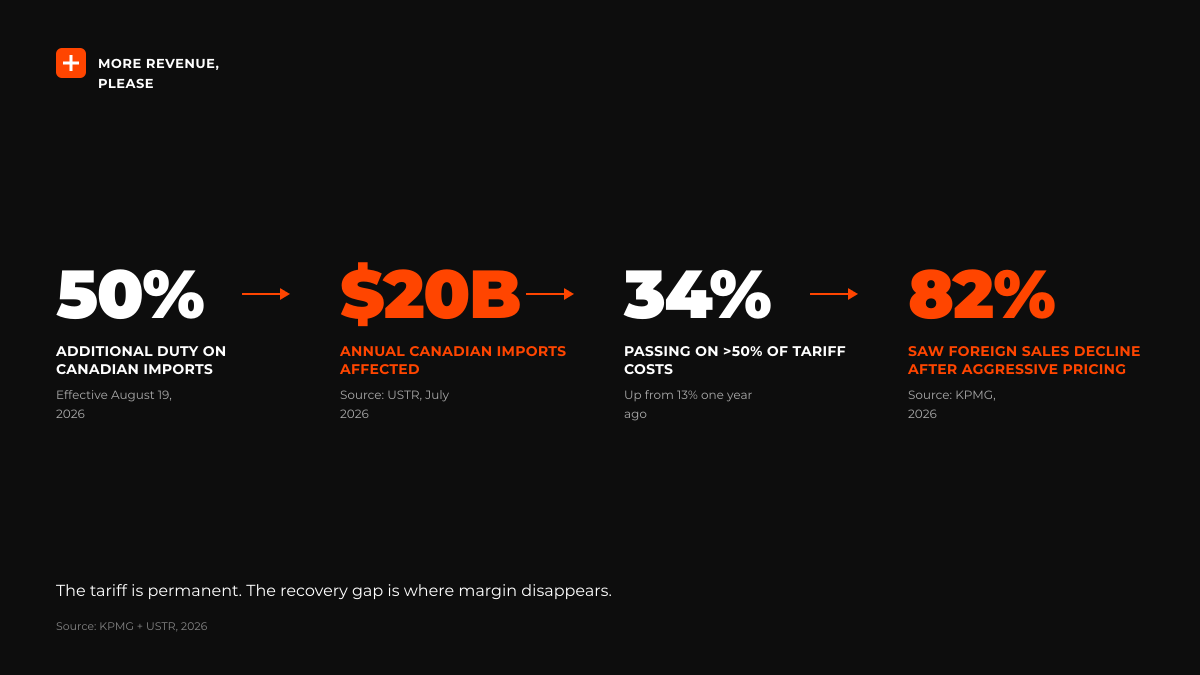
Most CFOs look at that figure and conclude that price increases cost customers. That is not what it shows. It shows that raising prices without a value story costs customers. The mechanism — surcharge versus repricing — determines the outcome more than the magnitude of the increase.
Why Most Price Increases Fail
A surcharge tells your customer the tariff is their problem.
A repriced offer tells your customer what they continue to receive for the new price.
Both end with a higher number on the invoice. Only one protects the relationship.
When a business adds a line that reads "Tariff Adjustment: +8%", it does three things simultaneously. It surfaces the tariff as the reason for the increase. It invites the customer to question whether that increase is legitimate. And it removes the product value from the frame — the customer now compares your cost to the cost of switching, not your value to the value of switching.
Customers who feel like they are absorbing a business's cost problem go looking for alternatives. Customers who feel like they are paying for something they understand and value do not.
The difference between those two outcomes is one paragraph. Written before the notice goes out. That paragraph is not a communication exercise. It is a pricing decision.
The Anatomy of a Good Repricing
"Effective August 19, a Section 338 Tariff Adjustment of 8% will be added to all invoices for [Product]."
That is a surcharge. Here is a repricing:
"Effective September 1, the price of [Product] is $X. This reflects updated cost structures across our supply chain. What does not change: [delivery timeline], [quality specification], [service terms]. We have absorbed as much of this adjustment as possible before passing on the remainder."
Same number. Completely different frame.
The first notice gives the customer a category: cost pass-through. The customer immediately calculates whether a competitor would charge less. The second notice gives the customer a product: a known offering at a new price, with value clearly articulated. The customer evaluates the value, not the tariff.
The timing matters as much as the language. A notice sent before August 19 is proactive. A notice sent after is reactive. That shift changes every conversation that follows.
Who Is Winning Right Now
The businesses holding margin through tariff pressure in 2026 share three characteristics.
They knew their exposure before the announcement. They had mapped which products touched Canadian supply, which suppliers were covered, and what percentage of production cost was exposed. When the proclamations were signed, they were executing a plan — not building one.
They separated what to absorb from what to pass on. Not every product with Canadian inputs needs a price increase. Products with domestic alternatives can hold price and protect volume. Knowing which is which before August 19 determines whether the response looks strategic or panicked.
They built the value story before sending the notice. The repricing conversation happened before the invoice changed. Customers who received advance notice with context stayed. Customers who received a retroactive surcharge without context pushed back or left.
What To Do in the Next 8 Days
Audit your Canadian import exposure — product by product. Identify every product that touches Canadian supply. Map it against the Section 338 covered categories. This is a product-level exercise. Know which products (and product variants, if you track inventory by SKU — the individual code for each distinct item you sell) are affected, which suppliers are involved, and what Canadian-origin materials represent as a share of what it costs to make or source each one.
Model the cost impact at the full 50% rate. Model the full 50% on Canadian-origin content and understand the worst case first. Then build backward to determine what is absorbable and what must be passed on.
Separate the response by product. Hold price where you can absorb. Reprice where you cannot. A blanket surcharge across all products damages trust on the ones that did not need it — and trust is harder to recover than margin.
Write the value paragraph before you send the notice. For every product requiring a price increase, write one paragraph: what does the customer continue to receive for this new price? That paragraph is the entire protection.
Reprice — do not surcharge. Remove the tariff adjustment line. Raise the product price. Attach the value paragraph. Give customers 10 to 14 days before the new price takes effect.
Lock supplier contracts where you can. If any Canadian suppliers will hold pricing into Q3 or Q4, lock those contracts now. Every day after August 19, that window narrows.
The Revenue Nobody Celebrates
The margin you protect this week does not appear anywhere as a win.
It does not show as new revenue. It does not register as a deal closed or an account won. It shows — quietly, six months from now — as a margin line that held while competitors compressed, as accounts that stayed while others lost theirs, as a cost structure that did not permanently reset downward.
That is the hardest revenue to defend. Nobody builds a dashboard for it. Nobody reports on the costs that were not absorbed. But every CFO who has watched margin compress across 12 months of tariff pressure will tell you the same thing: the margin you protect in the first week of a permanent cost change is the margin you get to keep.
Section 338 has no expiration date. The margin you absorb in August becomes your new floor — permanently. The businesses that treat this week as a pricing decision will hold margin. The businesses that treat it as an accounting event will spend the next year working with a cost structure they cannot undo.
August 19 is 8 days away. The repricing window is open right now.
Get the Book
Protecting margin under cost pressure is one of 100 revenue moves covered in More Revenue Please by Nader Sabry — available on Amazon.