
On August 6, the BLS dropped its Q2 2026 productivity numbers. Most CFOs caught the headline: productivity up 2.2%. That was the easy part.
What was underneath it is more interesting.
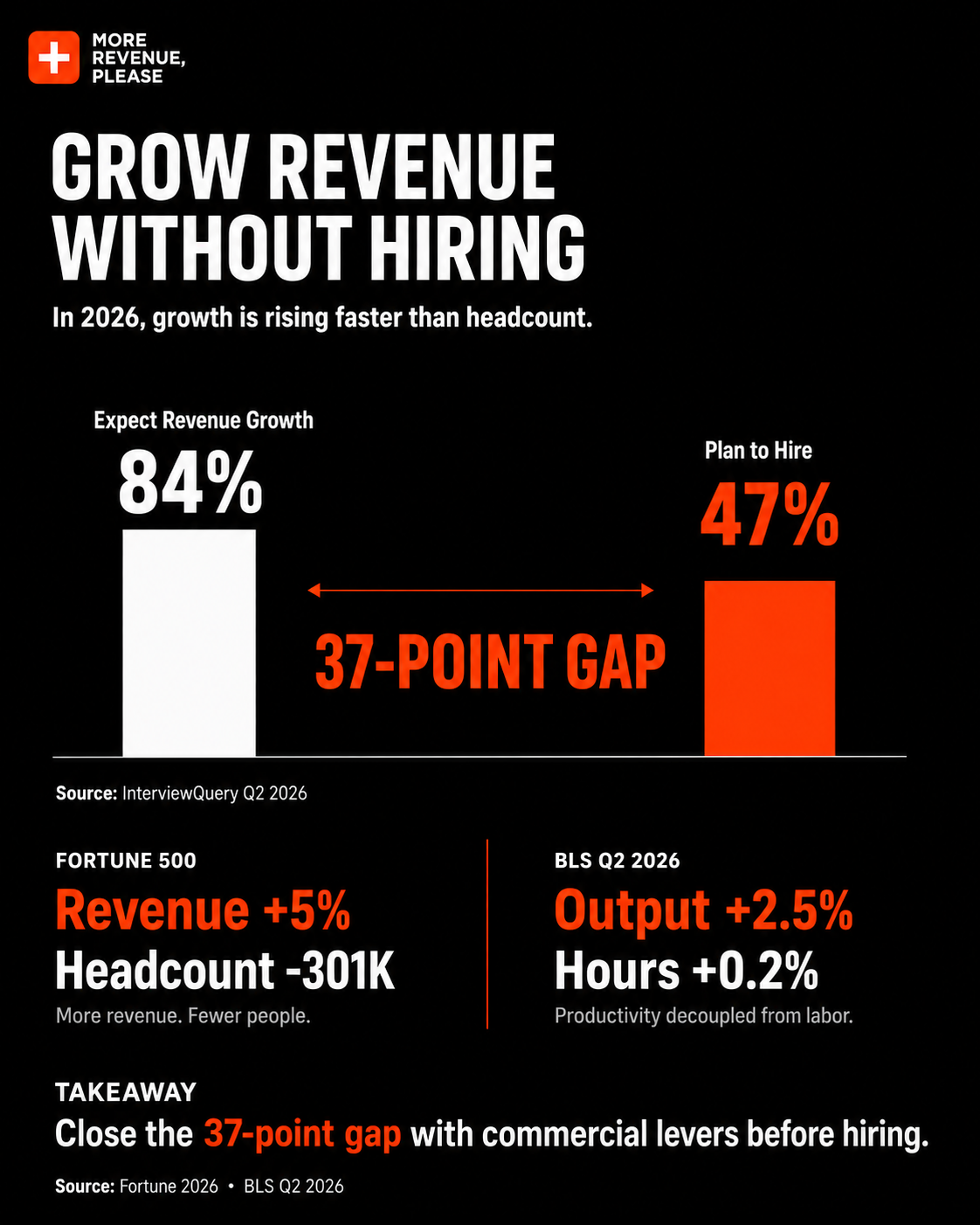
Output grew 2.5%. Hours worked grew 0.2%. Workers’ share of that output hit 52.9% — the lowest since 1947. Not since the post-war era has the gap between what employees produce and what they’re paid been this wide.
One week earlier, Fortune ran its Fortune 500 analysis: headcount fell 301,049. Revenue rose 5% to $21 trillion. Profits rose 12% to $2.1 trillion.
Two separate datasets. One conclusion.
Revenue and headcount have decoupled. The businesses winning in 2026 built plans around this early. The ones still treating “grow revenue” and “hire people” as the same equation are watching margin compress while the answer sits right in front of them.
The Default Assumption Is Wrong
Most revenue planning conversations run one direction: we need to grow revenue by X, so we need to hire Y people. More customers means more account managers. More products means more support staff. More markets means more local teams.
It worked well for decades when the real bottleneck was human capacity.
That’s not consistently true anymore. In a significant and growing number of businesses, the bottleneck is commercial design — not people. The capacity already exists. It’s just not pointed at a revenue outcome.
That distinction matters, because the two problems need completely different solutions. If capacity is the constraint, you hire. If commercial design is the constraint, you hire and the problem gets slightly easier — but it doesn’t go away. You’re adding cost without fixing the root cause.
InterviewQuery surveyed business leaders in Q2 2026. 84% expect sales growth this year. Only 47% plan to hire. The 37-point gap isn’t wishful thinking. It’s a structural conclusion that a significant portion of business leadership has already reached: revenue growth and headcount growth are separable, and separating them is now a deliberate choice, not an accident.
What the Data Actually Shows
The BLS Q2 2026 preliminary report is worth reading slowly. Output — actual goods and services across the non-farm business sector — rose 2.5% year-over-year. Hours worked rose 0.2%. The ratio between those two numbers is productivity, and at 2.2% annual growth, it’s a meaningful and sustained improvement in what each hour of work produces.
Real hourly compensation fell 3.1% in Q2. Most labour economists focus on that number because it speaks to worker welfare. But for a CFO or founder, there’s a different implication: the business is capturing the productivity gain. More output per hour at lower real compensation per hour means the gap between output and cost is widening in the business’s favour.
That gap is sitting somewhere inside your business right now. The question is whether it’s been pointed at a commercial outcome.
The Fortune 500 data shows what happens when it is. The largest companies in the world collectively employed 301,049 fewer people than the year before. Revenue grew by more than a trillion dollars. Per employee, the improvement in commercial output wasn’t marginal — it was structural.
B2B SaaS provides the most precise sector-level measure. Median revenue per employee hit $193,000 recurring in 2026 — up 29% in a single year. That’s not pricing power alone. That’s existing commercial teams closing more revenue in the same time, from the same relationships, through better-designed processes and faster cycles.
What Changed Inside These Businesses
Nothing changed about the capacity. What changed is how it’s being used commercially.
Businesses with rising revenue-per-employee ratios are doing three things differently from the ones stalling. None of these are complicated. They’re execution choices most businesses have the infrastructure to make — but haven’t systematically applied.
First, they’re converting faster. Pipeline velocity is a revenue multiplier almost entirely independent of headcount. When a sales cycle closes 20% faster, the same commercial team closes more revenue in the same period. The capacity to close was always there. The cycles were just longer than they needed to be.
Second, they’re capturing more of what they earn. There’s a persistent gap in most businesses between listed price and invoiced price — discounts granted informally, concessions made mid-deal, pricing exceptions that quietly become the norm. Every point of discount erosion is revenue earned and not collected. Closing that gap costs nothing and applies immediately.
Third, they’re activating existing customers. Every customer in your base was paid for through acquisition spend. Reactivation, upsell, and cross-sell generate revenue from that investment without additional acquisition cost. Businesses running structured programs against their existing base consistently outperform those treating acquisition as the only lever.
None of this requires a hire. All of it requires design and execution.
What Leaders Should Actually Be Asking
If you’re planning a headcount freeze this year, that’s often the right call given current cost conditions. But a headcount freeze without a commercial acceleration plan is just cost containment dressed as strategy. You’re reducing the size of the operation without increasing the commercial output of what remains.
Most CFOs are asking: “Can we grow without hiring?”
The data already answered that. Yes.
The more useful question is: “Where exactly is the revenue sitting inside this business right now, and what specifically is stopping us from converting it?”
That question leads somewhere different. It leads to looking at pipeline stages and finding where deals stall. It leads to reviewing the gap between listed price and invoiced price and understanding why it exists. It leads to pulling a list of lapsed customers and asking what it would take to bring them back. It leads to reviewing billing cycles and asking what moving them earlier would actually be worth.
These aren’t abstract strategic questions. They’re diagnostic questions with quantifiable answers. And the answers almost always reveal revenue that’s already present, already earned, or already owed — just not yet captured.
Five Places to Look Before Any Growth Conversation Involves a New Hire
1. Pipeline velocity
Map your current average sales cycle by stage. Where do deals stall? A 20% reduction in days-to-close is not a heroic target — it’s often achievable through better qualification at the front end, cleaner handoffs, and faster follow-up. That 20% improvement translates directly into more revenue closed by your existing team this period.
2. Pricing realization
Pull the gap between your list price and your average invoiced price. This isn’t about being rigid in negotiations. It’s about understanding where revenue is being left on the table structurally — which deals are being discounted reflexively rather than strategically. Every point you close lands this quarter with no additional cost.
3. Renewal and retention
Run the math on what a single percentage point improvement in your renewal rate is worth in annual revenue. In most subscription businesses, this number is large enough to justify real attention. Your renewal motion already exists. Strengthening it doesn’t require growth headcount — it requires execution from resources already in place.
4. Customer reactivation
When did you last run a structured reactivation program against lapsed customers? These are people who chose you once, understood what you offer, and stopped for some reason. They already know you. A structured outreach to a defined lapsed segment typically converts at a fraction of new customer acquisition cost. The list exists. The revenue is there to recover.
5. Billing speed and cash acceleration
How long from a signed contract to a first invoice? How long from first invoice to payment? Every day of delay is free credit you’re extending. Prepay incentives, tighter billing cycles, and faster invoice terms can accelerate significant cash without requiring any new revenue to be won. The money’s already owed. The question is when you collect it.
The Real Lesson From the Fortune 500
The Fortune 500 result isn’t a story about layoffs generating revenue. It’s a story about commercial design preceding scale.
When your commercial systems are built to close fast, price clean, retain consistently, reactivate systematically, and bill accurately, revenue grows through the structure. You add headcount when demand exceeds the structure’s capacity — not to compensate for gaps within it.
The businesses that stall hire to fix systemic commercial problems. They add account executives to fix a conversion problem. They add customer success managers to fix a retention problem. They add administrators to fix a billing problem. The new people absorb the symptoms without treating the cause. Cost rises. Margin stays flat.
The businesses winning in 2026 fixed the system first. Then they scaled.
That’s the sequence. And it starts with an honest diagnostic of where the revenue is actually sitting, right now, inside the business you already have.
The BLS number that’ll define 2026 isn’t the productivity rate. It’s the 37-point gap between leaders expecting revenue growth and leaders planning to hire.
That gap isn’t optimism. It’s business design.
More Revenue, Please identifies 100 specific ways to grow revenue from inside your current operation — without adding headcount, without external capital, without waiting for a new market to open. Many of them apply to your business this quarter.
Sources
- U.S. Bureau of Labor Statistics — Productivity and Costs Q2 2026 Preliminary — August 6, 2026
- Indeed Hiring Lab — Q2 2026 Productivity and Costs Release: Productivity Keeps Growing, but Workers Aren’t Getting the Gains — August 6, 2026
- Fortune / Yahoo Finance — Record revenues. Record profits. The Fortune 500 is richer than ever — and employing fewer people
- InterviewQuery — Worker Productivity Is Up 4.9%, But Hiring Remains Frozen Heading Into 2026
- SaaS Rise — Median B2B SaaS Revenue Per Employee 2026