
The Scoreboard You’re Not Checking
Your costs are down. Output is up. The AI deployment report looks clean. Productivity numbers beat the benchmark. You presented the slides. The board nodded.
Now check the other scoreboard.
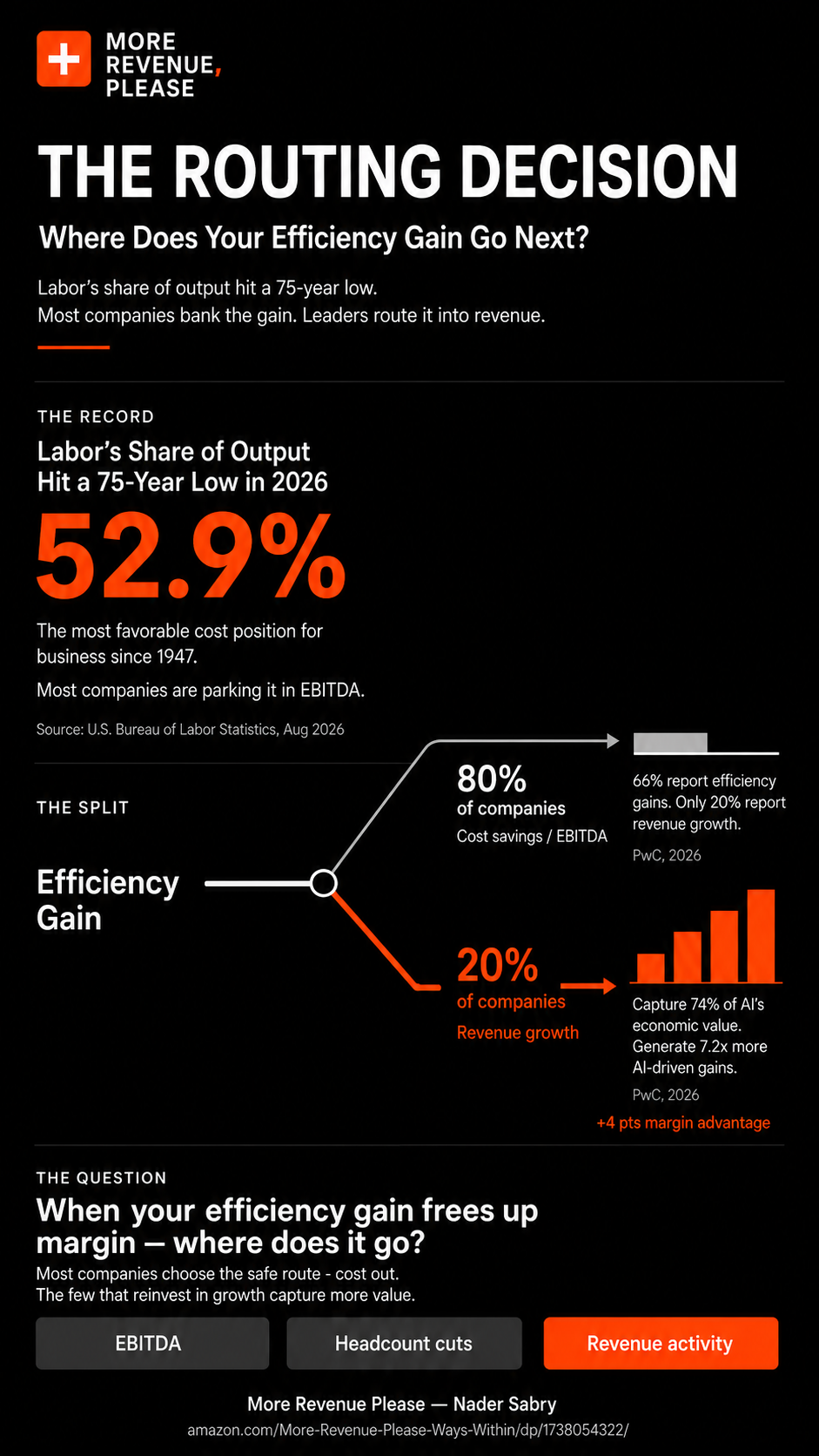
Twenty percent of businesses are capturing seventy-four percent of AI’s economic value. The remaining eighty percent — the ones with the efficiency gains, the leaner cost bases, the productivity dashboards — are splitting twenty-six percent between them.
The 20% aren’t spending more on AI. They aren’t smarter. They made one different decision: they pointed their productivity surplus at revenue growth instead of cost reduction. And they are now pulling 7.2 times further ahead of the average competitor every quarter they do it.
Your efficiency gains are real. The question is where they went.
The Record Nobody Is Talking About
In August 2026, the U.S. Bureau of Labor Statistics released Q2 productivity data. Buried inside the release was a figure that should have stopped every CFO in their tracks.
The labor share — the percentage of economic output that workers receive as compensation — fell to 52.9 percent in Q2 2026. That is the lowest level in the dataset, which runs back to Q1 1947. Seventy-nine years of records. A new floor.
What it means: businesses are extracting more output per dollar of labor cost than at any point in modern economic history. Productivity rose 1.4 percent in the quarter. Unit labor costs rose only 1.3 percent. Real hourly compensation — wages adjusted for what they actually buy — fell 3.1 percent.
Businesses are winning the productivity game in a way that has no historical precedent.
And yet. PwC surveyed 1,217 senior executives across 25 sectors in April 2026. Sixty-six percent of organizations reported efficiency gains from AI and operational improvement. Only 20 percent reported a corresponding increase in revenue.
The productivity is real. The revenue conversion is not happening.
Where the Surplus Is Going
When a business extracts more output per dollar of labor and per dollar of AI investment, the surplus has to go somewhere. In most businesses, it goes to three places — none of which are revenue.
The first is EBITDA. The productivity gain shows up as margin improvement. The CFO presents a stronger profit picture. The board approves. The competitive position has not changed.
The second is headcount reduction. The efficiency gain funds a round of cuts. Operating leverage improves. Revenue stays flat.
The third is reinvestment in more efficiency tools. The productivity surplus funds the next AI license. Efficiency compounds. Revenue does not.
None of these are wrong decisions in isolation. But none of them convert the surplus into a durable revenue advantage. They convert it into a cost position — which is temporary, because every competitor has access to the same tools, the same labor market dynamics, and the same AI vendors.
Cost positions get competed away. Revenue positions compound.
What the 20% Do Differently
PwC’s AI Performance Study is unambiguous on this point. The companies capturing 74 percent of AI’s economic value are not differentiated by how much AI they use. They are differentiated by where they point it.
Leaders aim their productivity gains at growth. They use the efficiency surplus to fund faster go-to-market — more capacity for sales, not fewer salespeople. They use it to price with more confidence — better margin data means better pricing decisions, not just better margins. They use it to take on more customers without proportional cost increase — the efficiency gain becomes capacity, not savings.
The result: top performers generate 7.2 times more AI-driven revenue and efficiency gains than the average competitor. Their profit margins run 4 percentage points higher. They are 2.6 times more likely to use AI to reinvent their business model rather than optimize the existing one.
They are not doing more. They are routing differently.
This connects to something Nader Sabry describes in the Growth Thinking framework: growth does not happen by accident. It has to be designed. Efficiency without a designed revenue conversion mechanism is not a growth strategy — it is cost management. The two look identical on a quarterly report until one of them starts compounding.
The Expiry Date on Your Surplus
The productivity advantage businesses hold in 2026 is real. But it has a shelf life.
Three forces will erode it if it is not converted to revenue first.
The first is wage correction. A labor share at a 79-year low is not a permanent equilibrium. It reflects a specific moment: AI adoption compressing costs faster than workers can renegotiate their share. That moment will not last. When wage pressure returns — and it will, as productivity gains become visible in corporate results — businesses that banked their surplus as margin will give it back as payroll. Businesses that converted it to revenue will have compounded.
The second is competitive erosion. The 20% who are routing their surplus toward growth are not staying still while you report your efficiency gains to the board. They are using the advantage to price more aggressively, serve more customers, and move faster than the market. The gap between the 20% and the 80% is not stable — it is widening every quarter.
The third is inflation absorption. Cost savings that are not converted to revenue get eaten by the next inflation cycle, the next input price increase, the next lease renewal. Margin is not a store of value. Revenue is.
The window to convert a genuine productivity surplus into durable revenue advantage is open in 2026. It is not permanently open.
The Routing Audit: Five Questions for Your Next Board Meeting
The practical question for any CFO or founder is not whether you have a productivity surplus. You almost certainly do — the macro data is unambiguous. The question is what you are doing with it.
Run this audit against your last quarterly results:
First: where did the efficiency gain land? If it is sitting in EBITDA improvement without a corresponding revenue initiative, you have banked the surplus, not deployed it.
Second: how much of your productivity improvement has gone into pricing confidence? Better output data should give you better pricing conversations. If your average selling price has not moved, the surplus is not reaching your revenue line.
Third: have you used the efficiency headroom to add revenue capacity? Lean operations should mean more capacity for growth activity — more customer acquisition, more account expansion, more product delivery per dollar. If headcount is down and pipeline is flat, the surplus went to cost, not growth.
Fourth: what is your revenue-per-employee trend? If productivity is up but revenue per employee is flat, your efficiency gains are staying inside the cost structure. The 20% show rising revenue per employee alongside rising efficiency — both moving together.
Fifth: is AI pointed at your cost base or your revenue base? The critical differentiator in the PwC data is direction, not volume. Audit where AI deployment is concentrated in your business. If it is predominantly in internal operations rather than customer-facing or revenue-generating activity, you are in the 80%.
The Conversion Mechanism
Routing efficiency gains toward revenue requires a deliberate mechanism — it does not happen by default. Three mechanisms work.
The first is capacity conversion. When productivity goes up, the freed capacity can either reduce headcount or expand output. Businesses that convert it to output — more customers served, more deals worked, more products delivered — turn efficiency into revenue. The constraint shifts from cost to demand, which is a better problem to have.
The second is pricing confidence. Stronger margin data gives finance and sales teams the information they need to hold price. Businesses that use their efficiency gains to improve pricing discipline rather than offer discounts to win volume convert the surplus into durable revenue per customer.
The third is speed-to-revenue. The 20% use AI not just to work efficiently but to move faster — shorter sales cycles, faster customer onboarding, quicker time-to-value for new customers. Speed creates compounding: faster revenue in means faster reinvestment, faster growth, and a larger base on which the next efficiency gain applies.
None of these requires more investment. They require a different routing decision on the investment already made.
The Real Risk in the 2026 Productivity Numbers
The BLS data showing labor share at a 79-year low is not primarily a story about workers. It is a story about where business leadership is pointing its advantage.
The businesses that will look back at 2026 as a turning point are the ones that recognized the productivity surplus as a revenue opportunity and built the mechanism to convert it. The ones that treated it as a margin story will report good EBITDA until the wage correction, the competitive erosion, or the next inflation cycle takes it back.
Efficiency is a starting position. Revenue is a destination. The 20% understand the difference.
The question for every CFO and founder reading this is the same: when your next board deck shows a productivity gain, where does the arrow point?
More Revenue, Please
Sources
Productivity and Costs, Second Quarter 2026 — U.S. Bureau of Labor Statistics — August 6, 2026 — https://www.bls.gov/news.release/prod2.nr0.htm
Three-quarters of AI’s economic gains are being captured by just 20% of companies — PwC Global AI Performance Study — April 13, 2026 — https://www.pwc.com/gx/en/news-room/press-releases/2026/pwc-2026-ai-performance-study.html
The CFO’s AI Agenda: From Automation to Advantage — BCG — May 2026 — https://www.bcg.com/publications/2026/the-cfos-ai-agenda-from-automation-to-advantage