
Most companies think they're in the same AI race as everyone else.
They're not. The race split — and the companies falling behind have no idea it happened.
McKinsey's September 2026 data shows the gap is no longer theoretical. It is compounding, quarter by quarter, in real earnings.
The Number Nobody Talks About
Eighty percent of workers report productivity gains from AI. That number gets quoted everywhere — used to justify AI budgets, defend AI strategies, reassure boards that progress is being made.
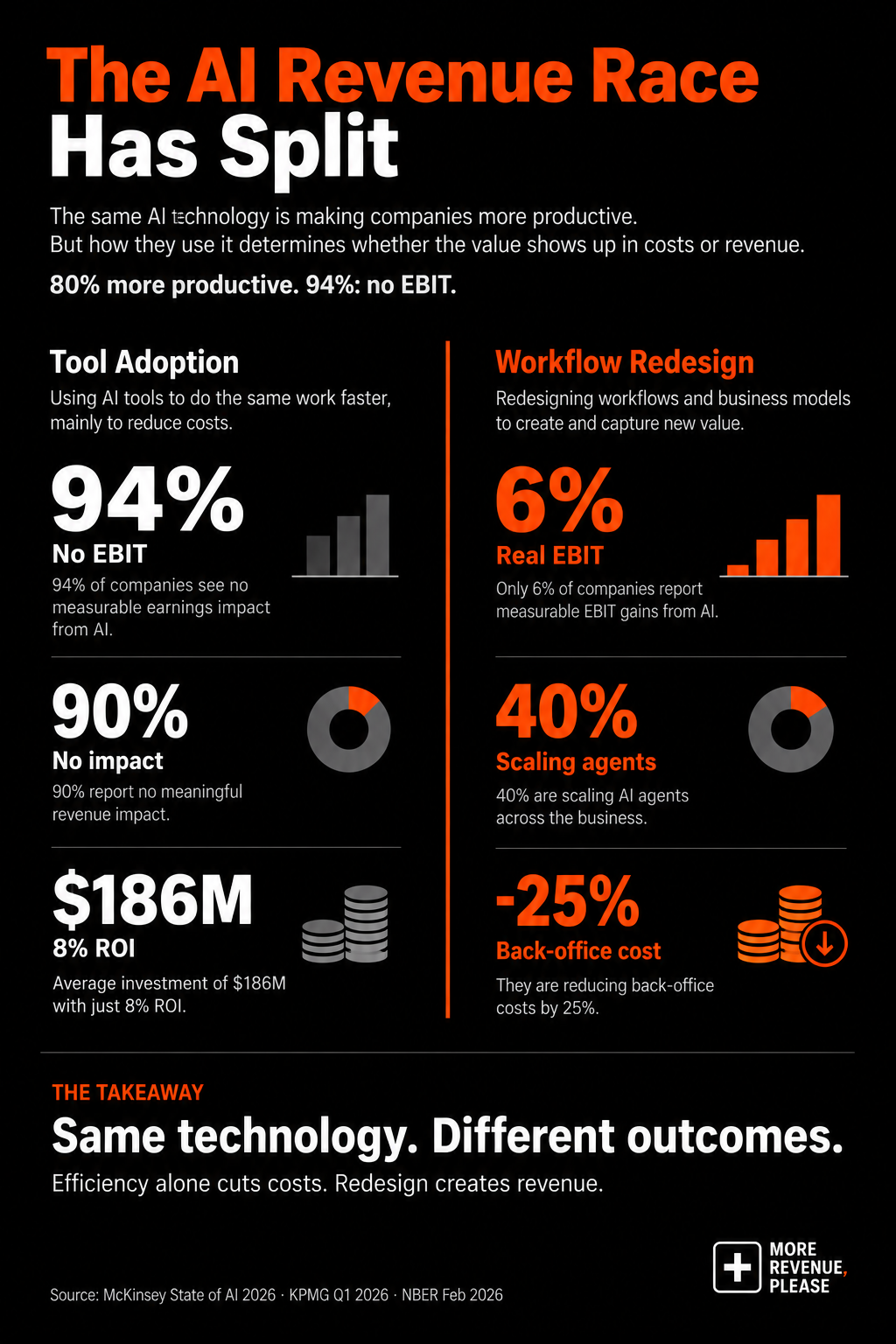
Here's the number that doesn't get quoted: only 6 percent of organizations can point to any significant earnings impact from AI. Not revenue projections. Not efficiency reports. Actual EBIT — earnings before interest and taxes.
McKinsey's 2026 State of AI survey covered 1,719 executives across 97 countries. Eighty percent of workers feel more productive. Six percent of companies have moved the needle. The gap between those two numbers is where most AI investment disappears.
KPMG's Q1 2026 Global AI Pulse survey found the average enterprise AI budget has reached $186 million. Only 8 percent report tangible return on investment. A 2026 National Bureau of Economic Research study of nearly 6,000 C-suite executives found roughly 90 percent said AI had no measurable impact on employment or productivity over three years.
The money is going in. The returns aren't coming out. That's a design problem, not a technology problem.
Why Productivity Gains Don't Reach the Income Statement
When a company installs an AI tool on top of an existing workflow, something predictable happens. Employees work faster. They feel more productive. The tool gets high marks in adoption surveys.
But faster isn't the same as more revenue.
If a sales rep uses AI to draft emails twice as fast, the productivity gain stays at the rep's desk unless the freed time converts to more closed deals, more calls, or higher pricing conversations. If it converts to the same number of deals with less effort, the company got a morale improvement — not a revenue increase.
This dynamic plays out across every AI deployment that improves individual output without changing business output. In a related piece on how efficiency gains flow to the wrong destination, Your Efficiency Gains Are Someone Else's Revenue maps the routing problem in detail — the productivity is real, it just ends up captured by the customer or competitor rather than the income statement.
McKinsey distinguishes between horizontal and vertical AI deployment. Horizontal tools — chatbots, copilots, writing assistants — scale quickly and produce what the research calls diffuse, hard-to-measure gains. They improve the experience of doing work without changing the output of the business.
Vertical deployments are different. AI that owns multiple steps in a defined business process — a customer escalation workflow, a pricing engine, a demand signal monitor — produces measurable output connected to a revenue line. That's where EBIT impact shows up.
Roughly 90 percent of function-level AI use cases remain in pilot mode. The business installed the tool. The process was never redesigned around it.
The 6 Percent Who Actually Got There
McKinsey classifies AI high performers as organizations where respondents attribute at least 5 percent of EBIT to AI and describe the technology's impact as significant. In 2026, that group is 6 percent of surveyed organizations — unchanged from last year.
What makes them different isn't the tools they use. It's what they were willing to redesign.
Nearly three-quarters of high performers report fundamentally redesigning workflows because of AI — up from 55 percent last year. Among all other respondents, the figure is about one-quarter.
High performers are twice as likely to have defined processes for measuring AI's financial impact — not adoption surveys or satisfaction scores, but baselines and before-and-after comparisons on revenue metrics. They're more than three times as likely to be scaling AI agents across most business functions.
The discipline is in connection — connecting the AI deployment to a specific, measurable revenue outcome before anyone declares success.
What Workflow Redesign Actually Looks Like
McKinsey itself is the most visible example of the high-performer playbook in action.
The firm now operates approximately 25,000 AI agents alongside 40,000 human consultants — a figure that grew from a few thousand agents in under two years. Back-office functions shrank by 25 percent as agents took over research synthesis and document preparation. Client-facing roles grew by 25 percent. Total back-office output reportedly rose 10 percent with fewer people.
This pattern — more output from the same or smaller headcount — is now showing up across industries. The Best Revenue Decision You Made This Year Was Not Hiring Anyone covers the Q2 2026 BLS data showing how the highest-performing businesses are growing revenue without growing headcount. AI workflow redesign is the structural enabler behind that number.
This isn't AI added to an existing research process. It's a research process rebuilt so that AI owns the retrieval, synthesis, and formatting steps — and humans own the judgment, client relationship, and delivery steps. The revenue output — more client work, delivered faster, at lower back-office cost — is defined before deployment begins.
Any company in any industry can make the same choice. Most haven't. The ones that have are building a compounding data advantage that makes the gap harder to close with time.
The Race That Split in 2026
Among companies with annual revenues above $1 billion, 40 percent are now scaling AI agents across one or more business functions — up from 27 percent last year. Earnings impact is beginning to show.
Among smaller organizations, AI agent adoption is 22 percent. Flat from last year.
Same tools. Same access. Very different trajectories.
The divergence is in workflow architecture, measurement discipline, and what each group was willing to redesign.
Large companies are moving from efficiency gains to earnings impact. They're building workflow infrastructure, measurement disciplines, and agent architectures that produce compounding returns. Every quarter ahead compounds the lead.
Smaller companies are still at 22 percent agent adoption, still mostly running horizontal tools, still reporting productivity improvements that haven't yet found a revenue line.
This isn't a technology gap. It's a deployment gap — and it's widening.
Why the Window Is Narrowing
AI advantage compounds in a specific way. Companies that redesign workflows first build three things simultaneously: the workflow architecture, the measurement baseline, and the institutional knowledge of what works in their specific business. Each becomes harder to replicate the longer a competitor has been building it.
A competitor that adopts the same AI tool six months later gets the tool, but not the data the redesigned workflow already generated. They start from zero on the learning curve.
Large companies are now 18 to 24 months into serious workflow redesign. Smaller companies are mostly at tool adoption. The compounding has started for one group. It hasn't started for the other.
The window to close that gap exists. It's narrowing.
What to Do This Week
1. List every active AI deployment in your business. For each one, write one sentence describing the revenue output it's connected to. If you can't write that sentence, the deployment is an efficiency tool.
2. Identify one workflow — not a task, a full workflow — where AI could own multiple consecutive steps with a measurable revenue output at the end. That's where your next AI investment goes.
3. Establish a baseline before deployment. The 6 percent with EBIT impact knew the before number so they could prove what changed.
4. Replace adoption and satisfaction metrics with revenue metrics. If an AI deployment has no revenue line, it has no success metric worth tracking.
5. Start one agent project. Unlike a chatbot — which responds to a prompt — an AI agent executes a sequence of steps autonomously: it retrieves, decides, acts, and checks results without human input at each step. That's where the 40 percent of large companies generating EBIT are now investing.
The Close
The AI productivity paradox is a design problem, not a technology problem. Eighty percent of workers feel more productive. Six percent of companies moved their earnings. The difference is whether AI is connected to a revenue outcome.
Large companies are 18 to 24 months into that connection. The compounding has started. Smaller companies have the same tools and a narrowing window to make the same design choice.
The race has split. The question isn't whether your company is running.
More Revenue, Please
If you're looking for practical ways to find and capture revenue already inside your business, More Revenue, Please by Nader Sabry explores 100 ideas across five revenue categories. Available on Amazon.
Sources
McKinsey & Company — The State of AI 2026 — September 2026 — https://www.mckinsey.com/capabilities/quantumblack/our-insights/the-state-of-ai
KPMG — Global AI Pulse Survey Q1 2026 — March 2026 — https://kpmg.com/xx/en/our-insights/ai-and-technology/enterprise-ai-survey-2026.html
National Bureau of Economic Research — AI and C-Suite Productivity Study 2026 — 2026 — https://www.nber.org/papers/w33582
U.S. Bureau of Labor Statistics — Productivity and Costs, Q2 2026 — August 2026 — https://www.bls.gov/news.release/prod2.nr0.htm
