
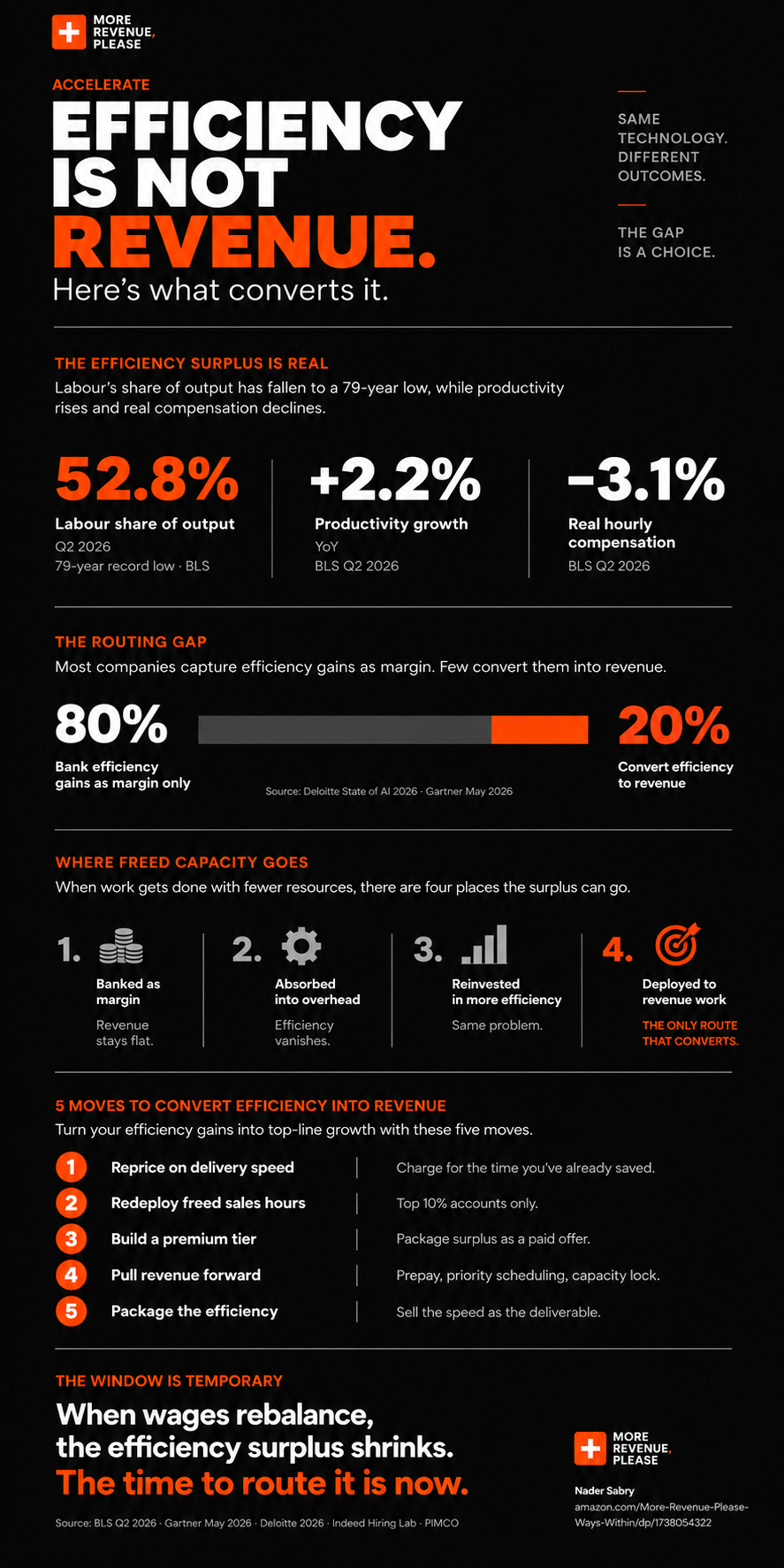
On August 6, the Bureau of Labor Statistics dropped Q2 2026 productivity numbers. One figure stopped most CFOs cold. The labour share of output — what workers take home as wages and benefits from everything a business produces, as opposed to profit the business keeps — fell to 52.8 percent. The lowest since records began in Q1 1947.
Productivity rose 2.2 percent year-over-year. Real hourly compensation fell 3.1 percent.
That's a 79-year gap between what businesses produce and what they pay for it.
And almost nobody is routing it into revenue.
The efficiency being measured here isn't just AI. It's any operational gain — process redesign, automation, workforce restructuring, tooling — that produces more output per hour worked. Across the US business economy, that improvement is now real, measurable, and mostly sitting idle.
Running lean produces margin. It doesn't automatically produce new revenue. Converting efficiency into revenue requires a deliberate decision most businesses never make: where does the freed capacity actually go?
Two-thirds of organisations report efficiency gains in 2026, particularly those using AI-driven and process improvements. Only 20 percent are growing revenue from them. The other 80 percent have better margins on the same revenue line. That's not growth. It's a slower version of the same problem.
The Confusion Between Efficiency and Revenue
Efficiency cuts waste. It compresses time. But it doesn't create a new customer, close a bigger deal, or shorten the cash collection cycle. What it creates is capacity — and capacity is potential, not revenue, until something routes it toward a paying transaction.
Most businesses treat efficiency as the destination. Cut costs. Protect margin. Report better EBITDA (earnings before interest, taxes, depreciation and amortisation). Done. The gap between what the business produces and what it collects never changes.
Gartner's May 2026 survey of 210 chief sales officers makes this plain. Sales teams are reclaiming an average of 4.8 hours per seller per week through process improvement — close to a full workday back in the week. Seventy-two percent of those organisations aren't reinvesting that time into high-value activities. The efficiency was captured. The revenue wasn't. The time went somewhere that doesn't show up on the P&L.
That's the gap. Not between what businesses know and what they don't. Between what efficiency creates and where it goes.
The Efficiency Routing Decision
When a business gets leaner, freed capacity has to go somewhere. There are four places it ends up. Only one builds revenue.
- Banking it as margin. Efficiency becomes a cost reduction. Revenue stays flat. This is the default for roughly 80 percent of businesses — EBITDA improves, the revenue line doesn't move.
- Absorbing it into overhead. Freed time disappears into lower-priority meetings, admin, and tasks that were already waiting for bandwidth. No margin gain. No revenue gain. The efficiency just vanishes.
- Reinvesting in more efficiency. Better tools, more automation, further process improvement. Useful — but it compounds the same problem rather than solving it.
- Deploying to revenue work. Freed capacity goes to higher-value accounts, faster deal cycles, premium service tiers, or new commercial offers. This is the only route that converts.
Most efficiency programmes are built to hit Route 1. CFOs call it margin improvement. Boards accept it as progress. Almost nobody asks what Route 4 would have produced. The 20 percent who grow revenue from efficiency chose Route 4 in advance — before the efficiency was captured. And they checked whether it actually arrived there.
Why Efficiency Doesn't Auto-Convert: The Three Gates
Three gates block the conversion. Most businesses never clear all three.
Gate 1 — Awareness: Do You Know What You Captured?
Can your team say precisely what efficiency was gained last quarter? Not in cost savings — in time freed, capacity created, output per headcount improved. Most finance teams can report the cost reduction with precision. Few can tell you the hours redirected or what a redirected hour is commercially worth in each function. What can't be measured as a positive asset can't be deployed as one. The first conversion step is reframing efficiency as a resource inventory, not just a cost line.
Gate 2 — Measurement as a Revenue Asset
Freed capacity behaves like perishable inventory, not cash. It has value today that falls to zero if not deployed within the quarter — dissolved into whatever fills the space naturally. Most businesses record efficiency gains as permanent cost line reductions and move on. The more useful accounting treats freed capacity as a depreciating asset with a deployment deadline. That reframe changes the routing decision from optional to urgent.
Gate 3 — The Deployment Decision
Even when businesses know what they captured and treat it as time-limited, the deployment decision rarely gets made explicitly. Freed capacity distributes naturally — to whoever requests it first, to whatever was already being done. Revenue conversion requires a named decision: this capacity goes to these accounts, or this offer, with this revenue outcome attached, owned by this person, reviewed on this date. Without that, efficiency stays in Gate 3 indefinitely.
Five Moves That Convert Efficiency Into Revenue
These aren't strategic initiatives requiring months of planning. They're commercial decisions a CFO or founder can run this week using capacity that already exists in the business.
Move 1 — Reprice on Delivery Speed
If your operations are faster than they were 12 months ago, you're delivering more value per transaction and not charging for it. Pricing research consistently shows buyers across B2B and B2C pay meaningfully more for faster delivery, faster resolution, faster results. Find where delivery time has improved by 20 percent or more. Reprice the fast option at a 10 to 15 percent premium. No new headcount. No new infrastructure. Just the decision to charge for what your efficiency already delivers.
Move 2 — Redeploy Freed Sales Capacity to Highest-Value Accounts
When sales hours are freed by process improvement, the default is to spread that time across the full account base. That produces a diffuse revenue result — a lot of mild attention everywhere and high returns nowhere. The alternative: route all freed capacity to the top 10 percent of accounts by lifetime revenue potential. Concentrated time on the right accounts consistently outperforms time spread broadly. The capacity already exists. The routing is the only variable.
Move 3 — Build a Premium Tier Using Operational Surplus
If your operations can handle more volume without adding headcount, you have operational surplus. That surplus can become a commercial offer rather than a cost saving. Priority access, faster delivery, dedicated service — same infrastructure, higher price point, marketed to the segment of your customer base that values speed and reliability over price sensitivity.
The premium tier isn't a new product. It's the existing product packaged with the delivery advantage your efficiency already created.
Case study: Amazon Prime. In 2005, Amazon had built significant fulfillment infrastructure to support its retail operation. The efficiency created surplus capacity — the ability to deliver faster than the industry expected. Rather than banking that surplus as margin, Amazon packaged it as a premium membership tier at $79 per year. The offer was simple: free 2-day shipping. By 2026, Prime has grown to over 200 million members globally, with subscription services revenue exceeding $40 billion annually. Amazon's scale is unusual — but the mechanism isn't. Any business with operational surplus can package it as a priority or fast-track tier. The infrastructure requirement is whatever you already have. The decision is how to price what it can now deliver.
Move 4 — Pull Revenue Forward Using the Capacity Buffer
Operational efficiency creates lead time between intake and delivery. Use that buffer to offer pull-forward incentives — arrangements where customers commit and pay earlier in exchange for priority access or guaranteed pricing. Prepayment discounts, priority scheduling for customers who contract early, capacity reservation at current pricing before any adjustment takes effect. Customers who commit earlier give you cash before the period starts. You lock revenue when your capacity buffer is most favourable. The cash cycle compresses without changing the product or pricing model.
Move 5 — Package the Efficiency as a Client Deliverable
In professional services, consulting, and project-based B2B delivery, your operational efficiency is invisible to clients. They pay for outcomes. If you're now achieving the same outcomes in materially less time, you have two options: keep the margin, or turn the speed into a premium deliverable. Fast-track engagements, expedited timelines, priority retainer tiers with guaranteed turnaround. Clients with time-sensitive decisions will pay a significant premium for the same outcome in half the time. The efficiency you built internally becomes the service tier they purchase externally. The margin on your internal process is the floor of that value — not the ceiling.
The Wage Rebalancing Clock
This window isn't permanent.
Labour share at 52.8 percent is the result of years where productivity gains consistently outpaced wage growth. Both Indeed Hiring Lab's Q2 2026 analysis and PIMCO's research on US productivity trends reach the same conclusion: gains that don't reach workers build correction pressure, and the longer the gap holds, the sharper the adjustment when it arrives. That pressure is already showing — unit labour costs rose 1.2 percent in Q2 2026 after a prolonged period of flatness.
When wages rebalance, the efficiency surplus shrinks. Freed capacity costs more to maintain. Pricing advantages from faster delivery narrow as competitors close the gap. The window to build permanent revenue structures from today's conditions is months, not years.
The businesses that convert their efficiency into permanent commercial structures now — new pricing tiers, redeployed capacity, premium service offers, pull-forward contracts — will carry those structures forward after the window closes. The ones that bank the margin and wait will return the efficiency to payroll with nothing permanent to show for it.
The 79-year low in labour share isn't an invitation to coast on margin. It's a signal that the conversion window is open.
What to Do This Week
Three decisions convert efficiency into revenue. Make them before the quarter ends.
- Measure what you actually captured. Quantify freed capacity this quarter — in hours, delivery speed improvement, and output per headcount. Attach a commercial value and a deployment deadline before the quarter ends.
- Make the routing decision. Decide explicitly where freed capacity goes. Name the revenue outcome. Assign an owner. Set a review date within 30 days.
- Execute one of the five moves. Pick the one closest to your current position. Reprice for speed. Redeploy to top accounts. Build the premium tier. Pull revenue forward. Package the efficiency. Start within seven days.
Efficiency isn't revenue. But it's the raw material revenue is built from — if you decide to use it that way. Most businesses are sitting on the most productive operational conditions in 79 years of recorded history and routing none of it deliberately.
That's the gap. And it closes faster than most expect.
About More Revenue Please
More Revenue Please by Nader Sabry covers 100 ways to find and capture revenue already inside your business — uncaptured, too slow, or quietly leaking out. The Accelerate pillar directly addresses how to convert operational capacity into faster cash and permanent revenue structures.