
Your contracts say one price. Your invoices say another.
The gap has a name — revenue leakage — and 42% of CFOs describe it as structural, not occasional.
That’s not an accounting rounding error. That’s a revenue strategy problem.
The Two-Number Problem
Every business has two revenue numbers. The first is what your contracts say you should be collecting. The second is what actually hits your bank account.
Most businesses track the second number carefully. Very few compare it to the first.
The gap between the two is revenue leakage — and it compounds quietly, quarter by quarter, until a CFO runs a billing-to-contract audit and discovers the business has been systematically under-collecting on revenue it already earned.
This is not about losing customers. It’s not about pricing strategy failures or missed upsells. It’s about revenue your business earned, contracted, and then failed to collect in full. The customer signed. The deal closed. The money just arrived at the wrong number.
What Revenue Leakage Actually Is
Revenue leakage is distinct from churn, from competitive pricing pressure, from pipeline shortfalls. It operates entirely in the execution layer — between contract signature and invoice delivery.
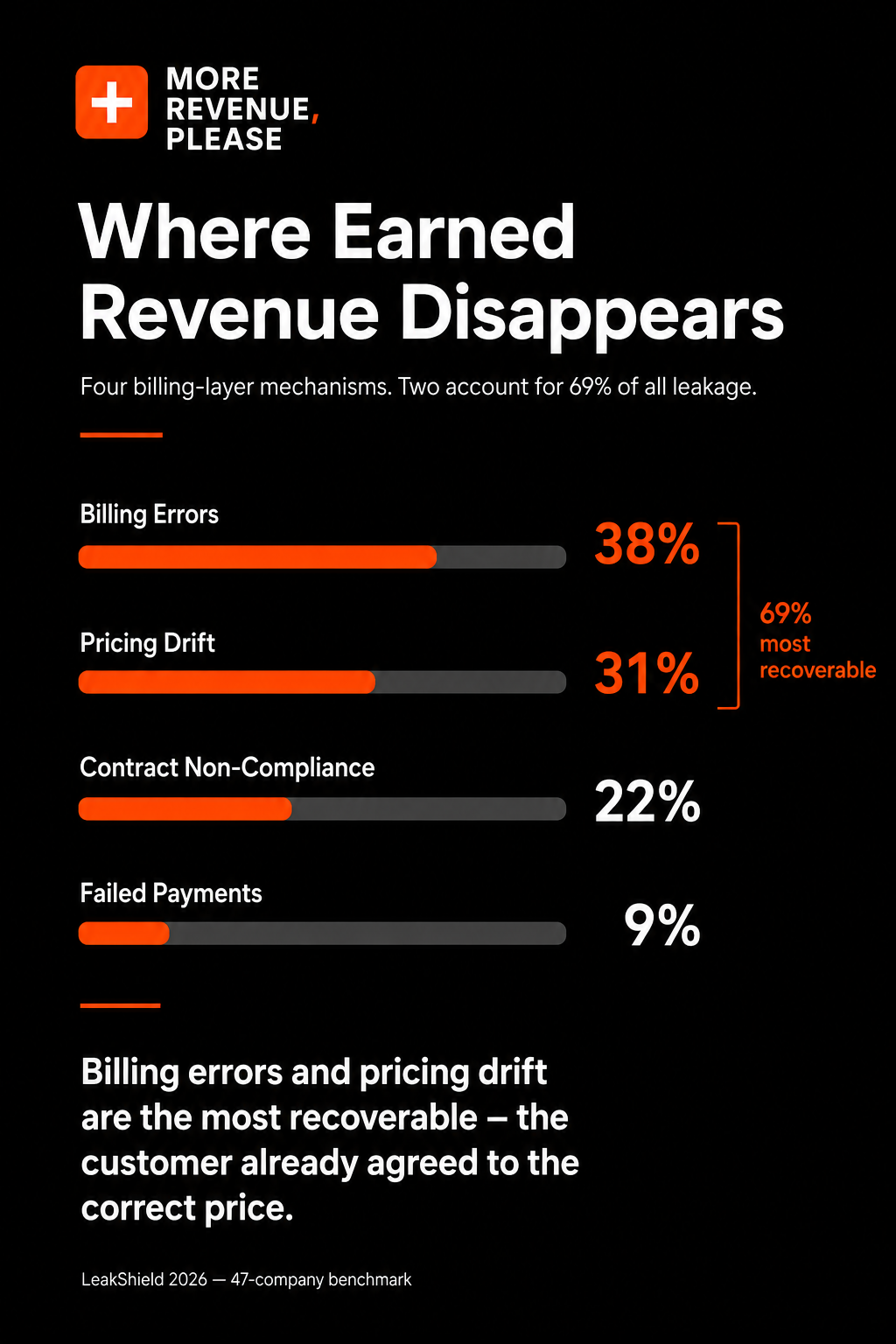
There are four primary mechanisms, and they compound differently:
Billing errors — invoicing the wrong amount, missing line items, or applying incorrect product configurations. This accounts for 38% of total leakage value, making it the largest single cause. It’s not fraud. It’s complexity — too many SKUs, too many pricing tiers, and billing systems that don’t map cleanly to negotiated terms.
Pricing drift — the gap that opens between the price on the contract and the price the billing system actually applies. Up to 40% of SaaS accounts continue on expired promotional or introductory pricing because the billing system never applied the rollback. Fewer than 35% of billing systems automatically apply contracted price escalators — the annual uplift clauses that most multi-year contracts include. The contract says the price goes up 5% in year two. The billing system says it hasn’t heard about that.
Pricing drift is also the most recoverable category. It doesn’t require renegotiation. The customer already agreed to the correct price — it’s in writing. The work is operational: find the gap, correct the billing record, apply the right rate going forward. No sales conversation needed.
Contract non-compliance — terms that were agreed to but never enforced. Volume thresholds that trigger pricing changes. Usage caps that weren’t monitored. Minimum commitment clauses that weren’t tracked. This represents 22% of total leakage and is almost entirely invisible without a systematic audit. Unlike billing errors, which tend to surface in reconciliation, contract non-compliance requires a deliberate cross-reference between the executed contract and the billing system — a check most revenue operations teams don’t run on a recurring basis.
Failed payment gaps — card expiries, failed renewals, and uncollected invoices that were never followed up. This is 9% of leakage, the smallest category, and the one most businesses are already trying to solve with dunning sequences.
The Scale of the Problem
Companies lose 3–9% of earned revenue to leakage, according to LeakShield’s 2026 benchmark of 47 companies and MGI Research analysis. The range varies by billing model — flat-rate businesses sit at the lower end, usage-based and professional services at the higher end.
At $10M ARR, that’s $300,000 to $900,000 gone annually. At $50M ARR, $1.5M to $4.5M. These are not exceptional edge cases. Forty-two percent of CFOs surveyed by EY describe revenue leakage as systematic at their company — a structural property of how their billing, CRM, and contract systems interact — not an occasional mistake.
The root cause is usually the same: manual processes. Forty-six percent of revenue operations leaders say their processes are mostly manual. Spreadsheets, email-approved discounts, and offline contract amendments create the conditions where the official contract number drifts from what actually gets invoiced. Nobody is being negligent. The system was just never designed to catch the gaps.
This is also why leakage concentrates in the billing layer rather than the sales layer. Sales teams close deals on the agreed terms. The problem is what happens three months later when a promotional period expires, or eighteen months later when the year-two escalation clause should have triggered. By then, the deal team has moved on and nobody is watching.
NRR Compression Isn’t Just a Churn Story
The industry conversation about NRR compression has focused almost entirely on churn and downgrades. But leakage is a third driver that rarely gets named.
Median NRR across private B2B SaaS compressed from approximately 105% in 2021 to 101% in 2024, according to SaaS Capital’s 2026 data. The explanations offered are usually competitive — more churn, more pricing pressure, fewer upsells.
But failing to enforce contractual uplift clauses alone suppresses annual revenue growth by one to three percentage points, even when customer retention remains strong. That’s not a churn story. That’s a collection story. The customers stayed. The contracts were renewed. The billing system just didn’t apply the agreed increases.
NRR compression built on billing drift is recoverable. NRR compression built on customer dissatisfaction is not. The two look identical in the metric. They require completely different responses.
This distinction matters especially for businesses tracking dollar retention versus logo retention — where NRR can diverge sharply from customer count trends. Leakage suppresses dollar retention without touching logo retention at all, which makes it easy to misread as a pricing or expansion problem when the real issue is operational.
The Metric Nobody Tracks
Most businesses measure revenue in three ways: ARR (what they expect to collect based on contracts), revenue (what they collected), and NRR (how much retained revenue grew or shrank). None of these metrics directly surface the gap between contracted price and invoiced price.
The missing metric is the collection rate — actual revenue collected divided by contracted revenue (what all signed, active contracts say should have arrived in the period).
How to calculate it: take your contracted MRR or ARR from your CRM or contract management system — the number that represents what active signed agreements say you should receive. Divide your actual collected revenue by that number. The gap is your leakage rate. A collection rate below 97% indicates structural leakage. Most businesses have never run this calculation.
Leakage persists not because it’s hard to fix once found — it’s operationally straightforward — but because most businesses are measuring the wrong things to find it.
The collection rate also has a diagnostic function beyond the overall number. Breaking it down by contract cohort — by year signed, by product line, by billing model — shows where the drift is concentrated. Multi-year contracts signed two or more years ago tend to have the highest gap, because they have had more time to accumulate pricing drift and unenforced escalations. That’s where the largest single recoveries typically come from.
Five Actions CFOs and Founders Can Take This Quarter
1. Run a billing-to-contract audit. Pull the last 90 days of invoices and match them line by line against signed contracts. Identify every instance where invoice price is lower than contract price. Categorise by type — billing configuration error, expired promotional pricing, escalator not applied, or contract term not enforced. Most businesses find this exercise alone recovers 1–2% of ARR in the first cycle.
2. Check price escalator automation. What percentage of your active contracts include annual uplift or price escalation clauses? Of those, how many are applied automatically by your billing system versus manually by someone on the team? Manual application has a failure rate. Find it before it compounds another year.
3. Audit promotional pricing rollbacks. Identify every account currently on promotional, introductory, or discounted pricing. Cross-reference against the promotion expiry date in the contract. Flag every account that should have reverted to standard pricing and hasn’t. This is frequently where the largest single leakage amounts sit.
4. Implement discount governance. Define who can approve discounts at what level, what documentation is required, and — critically — how discounts are recorded in the billing system rather than just the CRM. A discount that exists in Salesforce but not in your billing platform is a pricing drift event waiting to happen.
5. Measure your collection rate monthly. Contracted revenue versus actual revenue received. Track it the way you track NRR. A rate below 97% warrants a full audit. A downward trend warrants immediate investigation.
The Compounding Cost
Revenue leakage doesn’t just cost you the leaked amount this quarter. It resets your baseline.
Every future price increase is calculated as a percentage of the price currently being collected — which is already below contract rate. Every expansion motion, every NRR improvement project, every renewal negotiation — all of it starts from a compressed foundation that leakage created.
A 3% leak sustained over five years doesn’t cost you 15% of ARR. It costs you more, because every year’s expansion is calculated off the year before’s leaked revenue. The compound effect is asymmetric in the wrong direction.
The businesses that close this gap don’t just recover the leaked amount. They reset the baseline from which all future growth is calculated. That’s the real return on a billing audit.
For the broader picture of how revenue gets compressed across multiple dimensions simultaneously, see Revenue Growth vs. Margin Compression — which covers the parallel erosion happening in cost structures even when the top line is growing.
Ready to Stop the Leak?
Revenue leakage is recoverable. The revenue is already yours — it’s in signed contracts. The work is operational: audit the billing layer, enforce the terms, and measure what you actually collect against what contracts say you should.
More Revenue, Please by Nader Sabry covers 100 ways to find, protect, and accelerate revenue already inside your business — including the billing and pricing levers most operators overlook.
Sources
- Revenue Leakage Statistics 2026: 47 Data Points for CFOs — LeakShield — 2026
- The 2026 Revenue Leakage Analysis: A CFO’s Guide — Conga — 2026
- Four Early 2026 SaaS Trends — SaaS Capital — 2026
- How to Identify and Avoid Revenue Leakage in 2026 — Zenskar — 2026
- Revenue Leakage: Complete 2026 Guide — LeakShield — 2026