
Revenue is falling and the standard response — more products — is making it worse.
Product sprawl is consuming the revenue that already exists.
Your best margins are already in the business. Something else is eating them.
The Instinct That Hurts You
When revenue drops, the pressure to act is immediate.
Most businesses respond the same way. Add a new product. Create a new bundle. Build a new offer. Open a new channel.
This feels like momentum. It is not.
Every new product splits your team's attention. Every new offer splits your customer's focus. Every new channel dilutes your budget. The business looks more active. Revenue does not reflect it.
The instinct to add more when revenue falls comes from a reasonable place: if this product is not working, maybe a different one will. If this channel is saturated, maybe a new channel unlocks growth.
The logic sounds right. The result is almost always wrong.
Adding more does not create revenue. It relocates the same resources across a wider surface area. At the same time, consumer spending is concentrating with fewer suppliers — not spreading more widely. The businesses capturing revenue in this environment are narrowing focus, not expanding it. Each product gets slightly less attention, slightly less budget, slightly less focus. The underperformers stay underperforming. The high-margin products that could grow do not — because the team is too spread to resource them properly.
The result: revenue stays flat or falls further. The business now carries more complexity on the same declining base. And the cycle restarts: revenue still falls, so add more.
What Happened Yesterday
On August 19, 2026, two of the world's biggest beauty companies reported earnings.
Both had been losing revenue for two years. Both had tried adding more — more brands, more markets, more distribution channels. Both had watched revenue fall anyway.
Then both made the same move. They stopped adding. They cut instead.
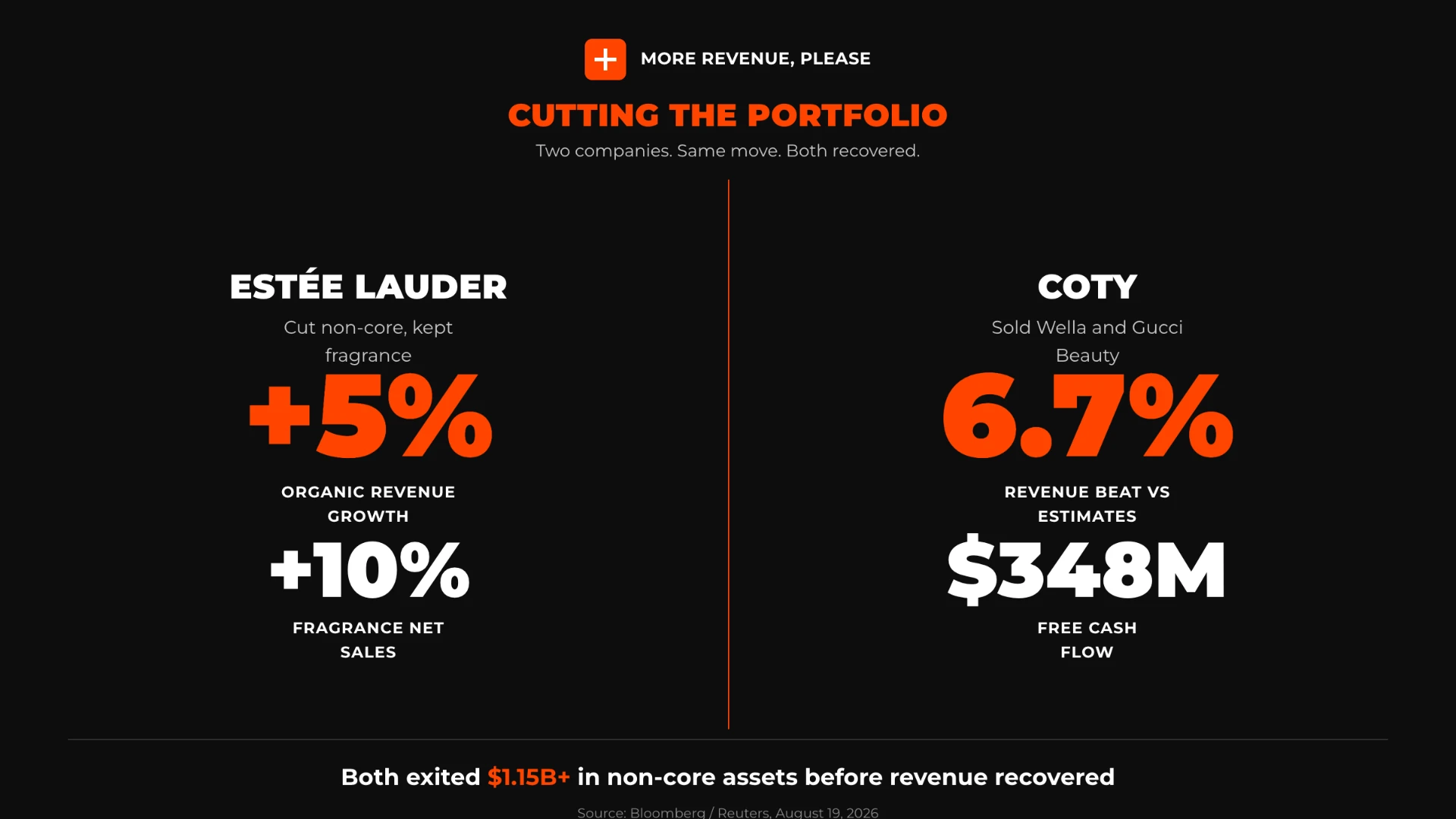
Estée Lauder reported organic growth of +5% in the fourth quarter — the first meaningful return to growth after multiple quarters of consecutive decline. Luxury fragrance led the recovery: Le Labo, Tom Ford, and Jo Malone grew net sales by 10%. The company raised its EPS (earnings per share) guidance for FY2027 (fiscal year 2027) to +24–34%. The stock jumped 13% on the day (Bloomberg, August 19, 2026).
Coty reported quarterly revenue of $1.27 billion against analyst expectations of $1.19 billion — a 6.7% beat. Free cash flow came in at $348 million, driven by working-capital discipline. Since December 2025, the company has exited $1.15 billion in non-core assets: Wella sold for $750 million and the Gucci Beauty license returned to Kering for $400 million (Bloomberg/Reuters, August 19, 2026).
Neither company launched a new product to recover. Both cut to what was already working.
The Strategy Behind the Numbers
Estée Lauder's plan is called "Beauty Reimagined." The actual move: stop resourcing the underperformers. Redirect everything into the premium portfolio — the brands with real margins, real customer loyalty, and real pricing power.
Before the pivot, Estée Lauder was spreading marketing, inventory, and team resources across dozens of brands competing in dozens of segments. Many were declining. The resources assigned to them were not reversing the decline. They were keeping the brands alive at cost — cost that came directly from the budget that should have been funding the premium lines.
The restructuring cut 10,000 roles and freed $1 billion in savings. A quarter of that went straight back into brand and consumer marketing for the premium lines already performing.
Coty's plan is called "Coty. Curated." The same principle applied differently. Fewer assets. Sharper focus. Exiting brands and licenses that consumed capital without returning proportional revenue.
Coty's overall profitability is still under pressure — operating margin fell from 16.1% to 8.8% in the quarter. That is expected. Portfolio simplification fixes the revenue line first. Margins follow as the cost base realigns to fewer, stronger lines.
The sequence matters. Revenue recovers before margins do. Businesses that cut and then wait for instant profit improvement misread the timeline. Estée Lauder's margin recovery will come in subsequent quarters. Coty is earlier in the same sequence. Both prove the model works — at different stages of execution.
The 80/20 Most Businesses Have Not Run
In most businesses, 20% of products generate 80% of revenue. That pattern is well-known.
What is less discussed: the bottom 20% of products typically consumes 40–60% of internal resources — team hours, inventory, marketing spend, customer service volume — without proportional return.
The high-margin products — the ones that could compound growth — are under-resourced. Not because the team is too small or the budget is wrong. Because the budget is shared with lines that consume more than they earn.
Most founders and CFOs know this in theory. Most have not run the numbers line by line to make it visible. The aggregate view hides it. Only the line-by-line view shows which products are subsidising which.
Running this analysis is not complicated. It requires three numbers per product line: revenue, gross margin, and cost-to-support. Those three numbers reveal the subsidy. Most businesses have never looked at all three together in the same view. Once you see it, the cut becomes obvious and the argument for keeping the underperformer disappears.
Why the Revenue Is Already There
Estée Lauder's luxury fragrance portfolio was already strong before the restructuring. Le Labo, Tom Ford, Jo Malone — premium brands with loyal customers and strong pricing power. They were not new ideas. They were existing assets being starved of the investment needed to grow.
When resources shifted from the underperforming brands to these three, fragrance net sales grew 10%. The products did not change. The allocation did.
The same pattern repeats in smaller businesses. A professional services firm generating 70% of revenue from one core service — but with seven other service lines demanding team time, proposal effort, and account management — is the same problem at a different scale. The seven peripheral lines feel like diversification. They are dilution.
The core service is under-resourced because the team is split across eight lines instead of one. Cut the bottom seven, redirect the capacity to the one that generates 70% of revenue, and the core grows without a single new product launch.
Cutting the underperformers does not shrink the business. It concentrates resources on the part of the business that can actually compound. This aligns with how buyers are now behaving: making fewer purchases, but spending significantly more when they commit. A focused portfolio positions you to capture that higher spend rather than lose it to diluted positioning. The revenue potential was always there. The portfolio was diluting it.
What Portfolio Complexity Actually Costs
Every product line you carry has a support cost that does not appear as a line item. It appears as diluted attention across the team.
The sales team pitches all eight lines. The account managers service all eight. The operations team fulfils all eight. Marketing budget gets split across all eight. Each line gets a fraction of what it would get if it were one of two lines instead of one of eight.
When you cut six lines and concentrate on two, the two remaining lines do not get one-quarter of the attention they used to get. They get four times the attention. That is the multiplier. The resources were always there. They were fragmented.
Coty's $1.15 billion in asset exits did not just improve free cash flow. It freed management bandwidth, board attention, legal overhead, and operational complexity. The capital value was visible. The attention value was not — but it was equally real.
Every line you carry below its true cost is a tax on the lines above it. The audit makes the tax visible. The exit removes it.
What To Do This Week
1. Pull revenue by individual product or service line — not in aggregate. Total revenue hides the problem.
2. Rank every line by gross margin contribution. A high-revenue line with 10% margin is destroying value. A smaller line with 60% margin is building it.
3. Identify the bottom 20% by margin. Calculate the true cost to support each: team hours, inventory, marketing spend, customer service volume.
4. Set a 90-day exit plan: sunset the line, reprice it above its true cost, or consolidate it into another offer. Not a review — a decision with a deadline.
5. Redirect freed resources — budget, team hours, marketing — to your top two or three highest-margin lines. Concentrated, not spread.
6. Do not replace what you cut with something new. Let the focus work for 90 days before evaluating results.
The revenue is already inside the business. The products that can drive growth already exist. They are under-resourced because the budget is shared with lines that need to be cut.
Cutting is not a shrink move. It is a focus move. The businesses recovering fastest in 2026 — Estée Lauder, Coty, and others — are the ones that understood this first. They did not discover something new. They stopped diluting what already worked.
The audit takes one afternoon. The decision is difficult once but only once. After that, the business runs leaner, grows faster, and stops asking why revenue is falling.
Related reading: how to build a subscription revenue layer into what you already sell, and how to work the Q4 federal revenue window before it closes.
Get the Book
More Revenue Please by Nader Sabry covers 100 ways to capture the revenue already inside your business — from portfolio simplification to repricing, reactivation, and more. → Get the book on Amazon