
The US government is required by law to spend $172 billion with small businesses this fiscal year — and most of that money hits the market in the next 43 days.
A "use it or lose it" budget rule forces every agency to spend remaining funds by September 30 or watch next year's budget get cut. A hard deadline changes how a business executes — the same discipline that separates leaders who commit to a specific revenue number from those who wait for certainty applies here.
If your business could serve any federal agency, that window is open right now.
The Government Has a Spending Problem
The US federal government runs on a strict fiscal calendar. Every agency gets a budget. Every dollar must be spent by September 30 — or it disappears.
Not rolled over. Not banked. Cut.
That is how the "use it or lose it" rule works. Contracting officers who fail to spend their Q4 allocation watch their budget shrink the following year. So when August hits, they move fast.
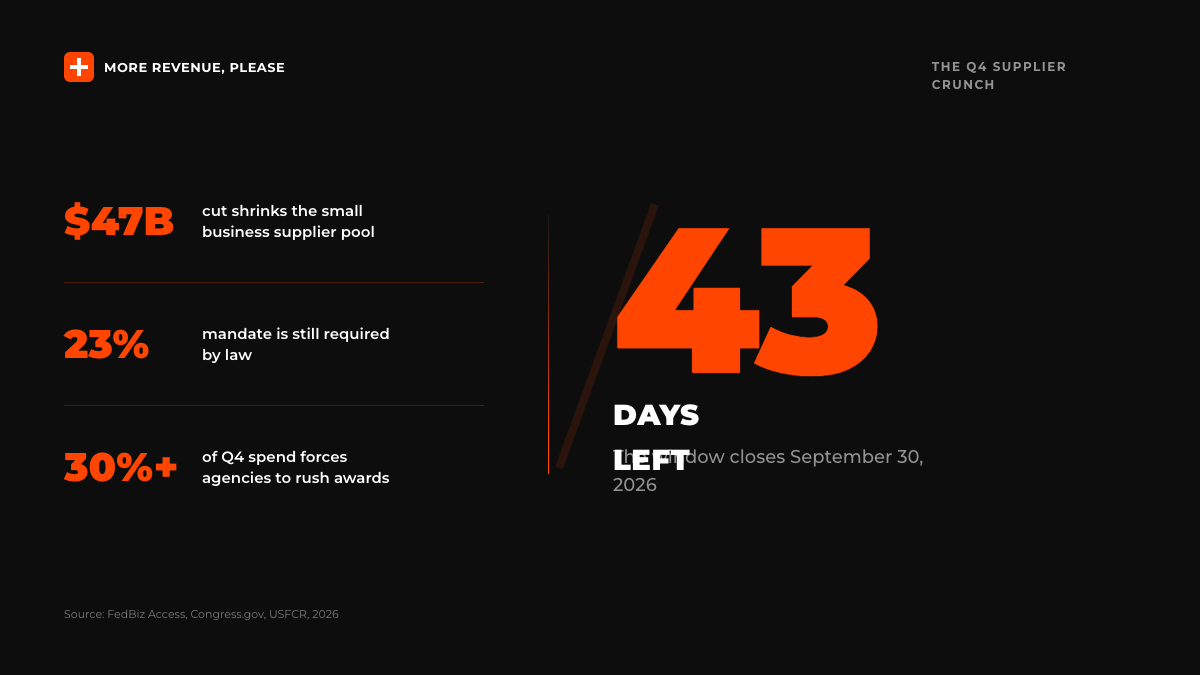
The result is a 43-day window where federal spending surges. More than 30% of all annual federal contracting dollars — across every department — land in Q4 (USFCR, 2026). That is not evenly spread across 12 months. It is concentrated in weeks.
Most founders have never heard of this window. The ones who know it treat it as their most reliable annual revenue event. They plan around it. They schedule capacity for it. And they collect contracts while their competitors are still running LinkedIn ads.
What the Numbers Actually Show
The US federal government spent $172.6 billion with small businesses in fiscal year 2026 (Deltek/SBA, 2026).
More than 30% of all federal contracting dollars land in Q4, July through September (USFCR, 2026). That is over $51 billion in concentrated spending in a single quarter.
The government is legally required to award at least 23% of all prime contract dollars to small businesses each fiscal year (Congress.gov, 2026). That mandate has been exceeded every year since 2013.
Agencies that miss these targets face institutional oversight. So contracting officers do not just want to award contracts to small businesses in Q4 — they are under pressure to do it. Missing the mandate gets noticed. Meeting it does not.
The window right now: 43 days. September 30 is the hard stop.
This Year the Pressure Is Higher Than Usual
Federal spending cuts eliminated $47 billion in small business contracting since January 2025 (FedBiz Access, 2026). More than 6,500 firms left the federal market entirely over the same period.
Agencies still have to hit their 23% mandate. They have fewer qualified suppliers to choose from. Q4 is where they make up the shortfall.
That creates something unusual: an active buyer market where federal agencies are searching for eligible small business suppliers right now — with money they must commit before the fiscal year closes.
This is not a normal procurement cycle. Urgency lives on the buyer side, not the seller side. That rarely happens in any market.
Why Most Founders Miss It Completely
Most founders assume government contracting is slow, complex, and reserved for large defense contractors. That assumption is 20 years out of date.
The federal government buys IT services, training, consulting, facilities management, accounting, marketing, staffing, logistics, legal services, software, translation, research, janitorial services, and thousands of other professional categories. If your business produces a service or product with a clear deliverable, a federal agency almost certainly buys it.
The barrier is not eligibility. It is awareness.
Most small business owners have never checked their SAM.gov registration. They have never searched USASpending.gov to see what agencies in their sector spent money on last year. They have never contacted an agency small business office.
None of those steps require a large team, a proposal specialist, or a government sales department. They require a few hours and a working email address.
The gap is not competitiveness. It is visibility.
The Simplified Acquisition Threshold: The Fast Lane
There is a procurement mechanism most founders never learn about: the Simplified Acquisition Threshold (SAT).
For contracts under $250,000, agencies can bypass most of the formal competitive process and award directly — or through a simplified competition — to registered small businesses. For contracts under $25,000, a single quote from a registered vendor is often sufficient.
This is where Q4 activity concentrates. Contracting officers with remaining budget and a hard September 30 deadline reach for simplified acquisitions first. Fast. Low paperwork. Mandate-compliant.
For a business billing $50,000 to $250,000 per year in professional services, a single SAT award closes a meaningful revenue gap. And because the same agencies often return the following year, that one contract becomes a multi-year relationship.
Most founders chasing enterprise clients are working 90-day sales cycles with no certainty of close. A simplified acquisition can move from posted opportunity to awarded contract in under 30 days.
Who Is Already Winning
Businesses that stay SAM-registered, understand the Q4 pattern, and maintain light relationships with agency small business offices treat this period as their most predictable annual revenue driver.
Some are small operations — 5 to 20 people — doing $500,000 to $3 million in federal revenue with no dedicated sales team. The contract comes to them because they are visible, eligible, and fast to respond when agencies are ready to move.
For example: a 12-person IT consulting firm lands two or three simplified acquisitions each Q4 from agencies they have worked with before. The base contracts run 12 months with two option years. That pattern alone funds the majority of their annual revenue, predictably, every year. No pipeline anxiety. No proposal theater. Just a registration, a relationship, and a response time faster than competitors.
Agencies need to close contracts quickly in Q4. They do not want to spend six months onboarding a new supplier. They award to businesses they have on file or that respond quickly to posted opportunities.
Speed and eligibility beat size. Every time.
What to Do Before September 30
These steps take days, not quarters.
Step 1 — Verify your size standard.
Every NAICS code has a small business size standard set by the SBA. Look up your primary NAICS code at sba.gov/size-standards. Confirm you qualify. Most professional services businesses under $20–30 million in annual revenue do.
Step 2 — Register or renew on SAM.gov.
SAM.gov is the federal vendor database. Without an active SAM registration, you cannot receive a federal contract. New registrations take 1–5 business days. Renewals are faster. Start today — time is the one variable you cannot recover.
Step 3 — Search open opportunities.
Go to sam.gov/contracts. Filter by your NAICS code. Select "small business set-aside." Open opportunities are posted daily. Also search usaspending.gov to see which agencies in your sector spent money last year and on which categories. That tells you exactly where to focus first.
Step 4 — Know your set-aside category.
Beyond the 23% base mandate, sub-goals exist for: small disadvantaged businesses (SDB/8a) at 5%, HUBZone businesses at 3%, service-disabled veteran-owned businesses (SDVOSB) at 3%, and women-owned small businesses (WOSB) at 5% (SBA, 2026). If your business qualifies for any of these, you compete in a smaller pool. Certification takes time, but SAM registration puts you in the base pool immediately.
Step 5 — Contact agency small business offices directly.
Every federal agency with significant procurement activity has a Small Business Office (SBO). These offices connect eligible vendors to contracting opportunities. In Q4, they are under pressure to award contracts to qualified small businesses. A direct email — stating your SAM registration, NAICS code, and core capability — takes 10 minutes and puts you on a list that gets checked when the next opportunity opens.
The Compounding Effect
Most federal contracts carry base periods plus option years — commonly one base year with up to four option years. A single Q4 contract win can generate predictable revenue for three to five years with no additional bidding.
That changes the economics entirely. The time invested in SAM registration, a few proposal responses, and agency SBO outreach is not the cost of a 43-day return. It is the front-end of a multi-year revenue channel that renews almost automatically when performance is solid.
Founders who discover this in year one typically regret not starting three years earlier. The businesses that entered the federal market in 2023 and 2024 are now collecting second and third option-year renewals with zero competition. New entrants are still figuring out SAM.gov.
The window opens the same time every year. The businesses already inside have a structural advantage over everyone who keeps waiting.
The Government Is Looking for Businesses Like Yours
The window is open. Agencies are under pressure to award. The mandate requires small business contracts. The only question is whether you are visible and eligible when they are ready to act.
More Revenue Please by Nader Sabry covers 100 ways to capture revenue your business is already positioned to earn — across five pillars: Create, Unlock, Accelerate, Expand, and Protect. Government contracting is one of the most reliable Expand plays available to any business with a clear deliverable and a federal buyer.
Get the Book
Capturing the federal Q4 window is one of 100 revenue moves covered in More Revenue Please by Nader Sabry — available on Amazon.