
Every month, revenue walks out the door. Not through lost deals — through the wrong billing model.
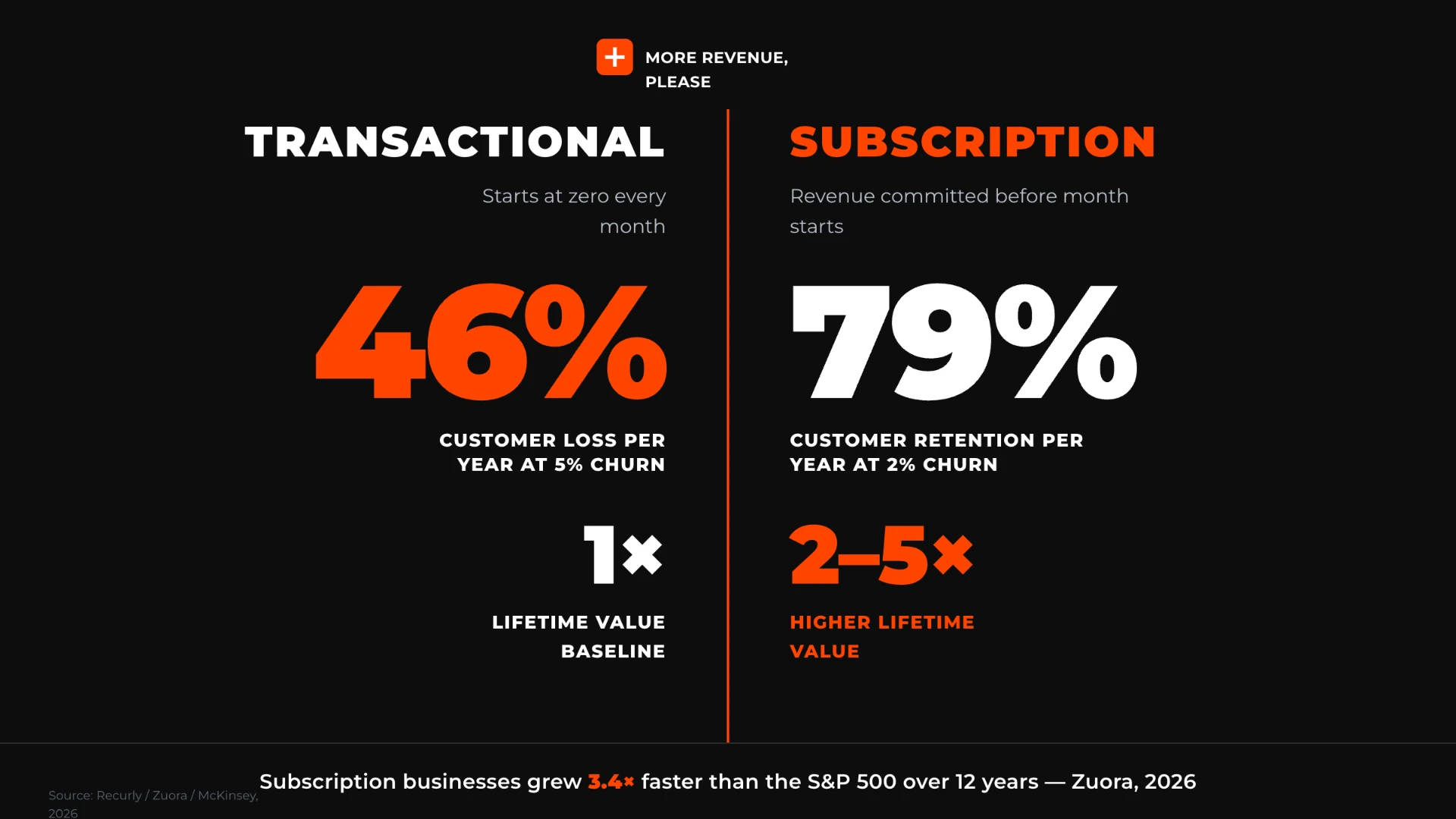
Subscription businesses now grow 3.4× faster than S&P 500 companies, not because they invented something new, but because they structured payment differently.
Your customers are already buying from you. The question is whether they have the option to commit.
The Business Model Most Founders Never Audit
Every business has a billing model. Most founders chose theirs by accident.
They priced the first project. Charged the first customer. That number became the template. For years, the billing model ran in the background — unchanged, unchallenged, quietly costing money.
The subscription economy has grown 435% over the last decade (Zuora, 2026). That is not a technology story. It is a revenue model story. The businesses growing fastest are not necessarily better at what they do. They built a different structure for getting paid.
The difference is not complexity. It is predictability.
A transactional business starts every month at zero. It has to re-earn revenue each month. Every client is a repeat decision. Every invoice is a new ask. The pipeline is always at risk.
A business with a subscription layer starts each month with revenue already committed. The floor is set before the month begins. Growth happens on top of a base.
Both businesses can serve the same customers. One runs with a structural advantage.
What the Numbers Actually Show
The data on subscription models is not subtle.
Subscription businesses deliver 2–5× higher customer lifetime value than businesses running transactional models (McKinsey, cited by Ordway Labs, 2026). That gap compounds across every customer relationship in the business.
Annual subscription plans deliver 50–60% more revenue per customer than monthly billing cycles — not because the product is different, but because of how the commitment is structured (Recurly State of Subscriptions, 2026).
The churn math tells the clearest story. Churn is the rate at which customers cancel — the single variable that most determines whether a subscription model is profitable. At 5% monthly churn, a business loses 46% of its customer base over a year. It has to replace nearly half its revenue just to stay flat. At 2% monthly churn, it retains 79% of customers annually. The same acquisition budget produces a completely different outcome (Recurly, 2026).
There is also the involuntary churn problem. Failed subscription payments cost businesses $129 billion globally in 2025 (Recurly, 2026). That is not churn from dissatisfied customers. That is revenue lost to mechanics — payment failures, card expirations, billing gaps. Businesses that fix this with basic retry logic recover material revenue immediately.
Free trials change the conversion economics further. Businesses offering a trial see a 64% lift in customer lifetime value in the US market and improve 90-day retention from 23% to 42% (Adapty, 2026). The trial filters for serious buyers. Customers who convert stay longer.
The global subscription economy reached $492 billion in 2024 and is projected to hit $1.51 trillion by 2033, growing at 13.3% annually (Grand View Research, 2026). That growth is not coming only from new subscription businesses. It is coming from existing businesses adding recurring revenue layers to what they already sell.
Why Transactional Businesses Leave Money on the Table
The transactional model feels safer. Each invoice is a discrete transaction. The business earns what it earns. The relationship is clean.
That feeling is misleading.
In a transactional model, the customer re-evaluates every time they purchase. Every transaction is a potential exit point. Every gap between purchases is a window for a competitor. The business works hard to win the first sale, then works equally hard to win the next one — from the same customer.
The subscription model removes that re-evaluation cycle. The customer commits once. The default is to stay. The business has to do something wrong to lose the customer, rather than something right to keep them.
This is the structural difference. Transactional businesses fight for every transaction. Subscription businesses protect a position.
The other issue is forecasting. A transactional business cannot predict next month's revenue with confidence. It knows last month. It knows the pipeline. But the actual number is uncertain until invoices land. That uncertainty drives conservative decisions — underhiring, underinvesting, underpricing.
A business with $40,000 in monthly recurring revenue knows its floor before the month starts. It can hire ahead of growth, invest in delivery, and price with confidence. The decisions are different because the information is different.
Who’s Already Making This Work
The move from transactional to subscription is not limited to technology companies.
A marketing agency that charges per project can offer a retainer. A retainer is a subscription. The deliverables are the same. The billing model is different. The agency trades variable monthly revenue for committed monthly revenue.
A software consultancy that bills hourly can offer a monthly advisory tier. Clients get a defined number of hours per month plus priority access. The consultancy builds monthly recurring revenue — MRR, the committed income the business earns every month regardless of new sales — without changing what it delivers.
A manufacturer that sells components can add a supply subscription — guaranteed monthly quantities, locked pricing, automatic replenishment. The client gets predictability on supply. The manufacturer gets a committed order book.
A professional services firm can create a compliance maintenance tier. Instead of billing once for an engagement, it bills monthly to monitor, update, and keep the work current. The client pays less per month than they would for a new project. The firm earns more over 12 months than from a single invoice.
None of these businesses became subscription companies. They added a subscription layer to something they already do. The product or service did not change. The structure of payment did.
B2B subscriptions already account for 55.2% of total subscription economy revenue (Grand View Research, 2026). The shift is not happening at the consumer level. It is happening in exactly the kinds of business relationships most founders already run.
What To Do This Week
The path from transactional to recurring revenue does not require rebuilding the business. It requires one new offer.
1. List your top ten customers by revenue over the past twelve months.
2. Identify what they bought more than once. That repeat purchase is the seed of the subscription offer.
3. Define what a monthly version of that purchase looks like. Same output, different payment structure.
4. Price the monthly version at a slight discount to the annualised one-time price. Give the customer a reason to commit.
5. Add an annual option at 10–15% further discount. Annual subscribers churn at a fraction of the rate of monthly subscribers. The upfront cash also improves working capital.
6. Offer it first to the customers who already buy consistently. They are the most likely to convert. They already trust the product.
The goal for the first 90 days is not to replace the transactional model. It is to build a base. Even ten customers on a recurring plan changes the financial picture. The business starts the next month with committed revenue. The floor shifts. The decisions shift.
One more thing on churn: 52% of subscription cancellations happen because the customer stopped using the product — not because they were unhappy (Recurly, 2026). The fix is engagement, not pricing. Build in a monthly touchpoint. Make the subscription visible. Active customers do not cancel.
The Pricing Structure That Captures Both Segments
Not every customer will convert to annual. That is fine. The goal is to offer both paths and let the customer choose their comfort level.
Monthly subscribers give the business cash flow flexibility. Annual subscribers give the business working capital and lower churn risk. A business running both tiers captures different customer segments without losing either.
The data supports offering a short trial window on the annual option. Free trials that lead to annual commitments lift customer lifetime value by 64% compared to direct monthly sign-ups (Adapty, 2026). The trial removes the risk from the customer's perspective. The annual commitment removes the churn risk from the business's perspective.
Hybrid models — a base subscription combined with usage-based charges above the base — report 21% median growth, outperforming both pure subscription and pure transactional models (Digital Applied, 2026). This structure works well for service businesses where monthly volume varies. The base fee covers the guaranteed work. The overage captures the expansion.
The Subscription Layer Is the Next Revenue Move
The business does not have to rebuild from scratch.
The customers are already there. The product works. The missing piece is the billing model — a structure that converts a series of one-time transactions into a committed, predictable revenue base.
Subscription businesses grew 3.4× faster than S&P 500 companies over the last 12 years (Zuora, 2026). That growth did not come from invention. It came from structure.
The question is not whether a subscription model fits the business. The question is what part of what the business already sells is worth paying for every month.
That answer is in the customer list. It is in the repeat orders. It is in the work that already runs on a recurring cycle but gets invoiced as if it is new every time.
The revenue is already there. The billing model is the only thing standing between transactional and recurring.
Get the Full Playbook
More Revenue Please by Nader Sabry covers 100 ways to find and capture revenue that is already inside the business — including how to build new revenue models from what you already sell.