
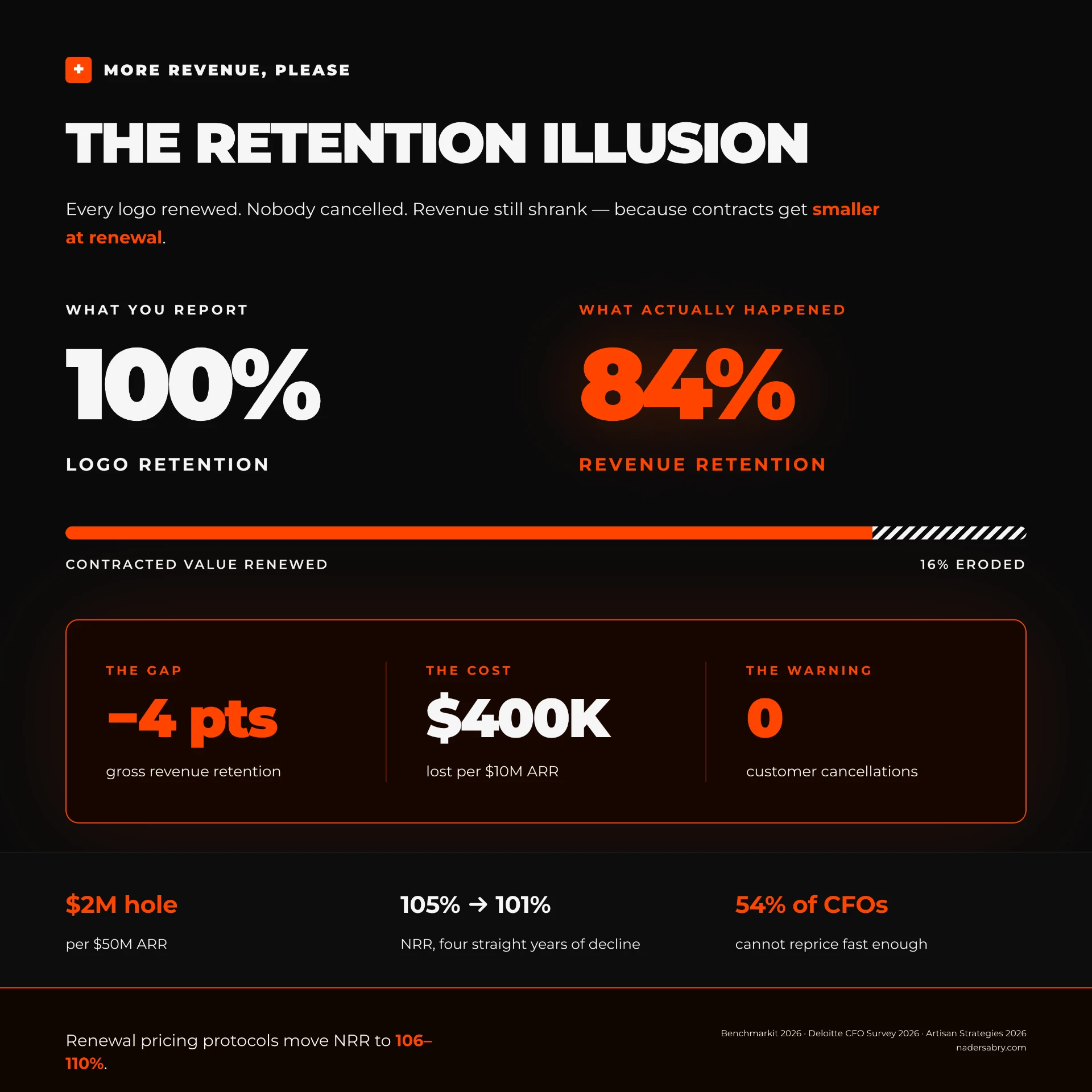
Your logo retention is 100 percent. Your revenue retention is 84 percent. Both numbers came from the same customers.
The gap is called the retention illusion.
If you are watching the wrong number, you are reporting growth while revenue quietly shrinks.
The Number That Is Hiding Your Revenue Problem
Most businesses track how many customers stayed. It is a clean, visible metric. It goes into the board deck. It goes into the investor update. And when it is high, the room relaxes.
But a customer staying is not the same as a customer paying the same amount. These are two different facts about two different things. Most businesses treat them as one.
In 2026, the median gross revenue retention (GRR) for B2B companies dropped from 88 percent to 84 percent. That is a four-point decline with zero customers lost. Source: Benchmarkit B2B SaaS & AI-Native Metrics Report 2026, via The SaaS CFO, July 2026.
On a $10M revenue base, that four-point drop is $400,000 in annual revenue erosion. On a $50M base, it is a $2M hole appearing in your baseline every year — before a single customer cancels.
No customers left. Revenue still fell. That is the core of the problem.
The businesses that understand this distinction will protect their revenue baseline. The ones that do not will keep reporting 100 percent retention right up until the number catches up with them.
What GRR Actually Measures
Gross revenue retention (GRR) measures what percentage of last year's contracted revenue renewed at the same or higher value — before counting any upsell, expansion, or new business.
It is the floor of your recurring revenue model. The minimum your business keeps from one year to the next if nothing grows and nothing is added.
One hundred percent GRR means every customer renewed at full value. Eighty-four percent GRR means customers stayed, but contracts shrank. The business is smaller than it appears.
The reasons are often invisible in the headline numbers. A customer renews with fewer seats after a headcount reduction. Another downgrades from an enterprise tier to a mid-market plan because procurement asked for savings. A usage-based customer's activity drops 20 percent. A founder under budget pressure pushes back on renewal pricing — and gets what they ask for, because the alternative was losing the logo.
In a 2026 Deloitte survey, 54 percent of CFOs said they could not adjust prices quickly enough because their organisations lacked a cohesive pricing strategy. The result shows up directly in GRR data.
These are not product failures. They are revenue protection failures — specifically at the renewal point, where the contract either holds or gives ground.
How Expansion Revenue Hides the Leak
Net revenue retention (NRR) includes expansion — upsell, cross-sell, and usage growth from existing customers. It is the metric most commonly cited when leaders talk about retention health.
And it can make a revenue base leak invisible.
Enterprise SaaS businesses report a median NRR of 118 percent in 2026. That number looks excellent in any deck. But if the underlying GRR is 84 percent, the expansion revenue from a narrowing group of high-value accounts is covering a four-point base erosion that grows every year.
Median NRR across private B2B SaaS fell from 105 percent in 2021 to 101 percent in 2024 — a sustained four-year contraction. The expansion layer is shrinking. The base leak continues.
When the top accounts plateau or eventually churn, the hidden base erosion surfaces all at once. What looked like a retention story becomes a revenue gap with no obvious cause — because the logo count still looks fine.
Why Contracts Shrink Without Customers Leaving
GRR erosion follows specific, predictable patterns. Understanding them is the first step to stopping them.
Seat count reductions. A customer cuts 15 percent of headcount. The contract renews with 15 percent fewer seats. Fully within renewal terms, entirely within the customer's right — and a guaranteed GRR hit.
Tier downgrades. Same customer, cheaper plan. This typically happens six to eight weeks before renewal when procurement gets involved and identifies subscription spend as a savings target.
Usage-based ratchets. Consumption falls — fewer API calls, lower storage, reduced transaction volume. The invoice follows it down. No cancellation, no negotiation, just quiet contraction.
Renewal concessions. Without a pricing protocol, account managers agree to hold price — or reduce it — to avoid the risk of losing the logo. The logic is understandable. The cumulative revenue effect across hundreds of accounts is not.
Each of these is individually small. Collectively, across any contract book above $5M ARR, they compound into the kind of four-point GRR decline now showing up across the market.
The 75th percentile GRR also fell — from 95 percent to 91 percent in 2026. This is not a problem concentrated at underperformers. It is happening across the distribution.
Who Is Getting This Right
Companies with expansion-friendly pricing structures achieve net revenue retention of 106 to 110 percent. They are not using new logos to cover base erosion — they have built expansion into the structure of each customer relationship from the start.
They treat renewal as a deliberate repricing event, not an administrative task. They track GRR per customer segment, per product tier, per cohort — not just as a blended company-level average that hides the problem inside a healthy-looking number.
They build renewal risk detection into their operating cadence. Ninety days before renewal, they review usage trends, support volume, and executive engagement signals for every account above a revenue threshold. Reviewing this kind of revenue performance by segment is the foundation of the process — something explored in detail in portfolio revenue recovery.
The difference is not better customers or better products. It is a deliberate revenue protection process built around the renewal cycle — run consistently, measured correctly.
What to Track Instead
Three numbers that belong beside logo retention in every CFO or founder dashboard:
GRR by segment. Separate renewal performance across SMB (small and mid-size businesses), mid-market, and enterprise. SMB NRR of 97 percent means base erosion is present. Enterprise NRR of 118 percent means expansion is masking it. Blending them produces a number that tells you nothing useful.
Renewal contract value versus prior year. For every renewing account, record whether it renewed at, above, or below last year's contract value. Track the distribution. The gap between logo count and contract value movement is exactly where the retention illusion lives.
Involuntary churn rate. Payment failures are recoverable revenue that never show up in logo retention reporting. Failed card transactions, expired payment methods, and billing errors cost the subscription industry $129 billion annually. Source: Recurly, 2025/2026. This is the most overlooked category of renewal revenue loss.
Five Moves to Protect Renewal Revenue
1. Separate GRR from NRR in your reporting. Run them side by side every month. The gap between them tells you how much expansion revenue is currently covering base erosion. If the gap is widening, the base problem is growing faster than the expansion layer can cover it.
2. Build a renewal pricing protocol. No contract should auto-renew at prior-year value without a pricing review. Even a 3 to 5 percent annual increase applied consistently at renewal — with a clear value rationale — recovers a significant portion of GRR erosion before it compounds across multiple cohorts.
3. Identify downgrade risk 90 days before renewal. Usage data, engagement scores, and support ticket volume all signal renewal risk well ahead of the contract date. Address them while the customer is still active and the relationship is intact — not after the reduced invoice has already been issued and accepted.
4. Add an expansion layer to your highest-retention customers. The accounts with the strongest renewal history are the lowest-risk place to introduce an add-on, a usage tier, or a recurring service element. Building a subscription revenue layer into top accounts moves GRR and NRR simultaneously, without relying on new logo acquisition.
5. Fix involuntary churn as an operational priority. Set up automated payment retry sequences, card updater services, and pre-dunning outreach before cards expire. Recovering failed payments requires no renegotiation, no pricing conversation, and no customer success intervention. It is the fastest category of renewal revenue loss to close — and the most overlooked.
Not every business needs all five. Identify which category of GRR erosion is largest in your book and start there.
The Bottom Line
Logo retention and revenue retention are different numbers. Most businesses report the first and get surprised by the second.
The 88 to 84 percent GRR shift is not a warning that something might go wrong. It is confirmation that revenue erosion is already happening across the market — at scale, without triggering the metrics most teams watch.
The businesses that protect their revenue baseline in 2026 and beyond are the ones that stop measuring customer count and start measuring contract value at renewal. The gap between those two numbers is not a rounding error. It is where the money went.
More Revenue Is Already There
More Revenue Please by Nader Sabry covers 100 ways to capture, protect, and accelerate revenue that is already inside the business. Renewal revenue protection is one of the fastest to act on. → Get the book on Amazon