
Revenue is up across Q2 2026. Profit is not following.
A structural gap between top-line growth and margin is widening — and most leaders cannot see it because the revenue number looks healthy. The dashboard is green. The boardroom is comfortable. And the problem is compounding underneath.
If your only measure of business progress is revenue, you will not see this problem until it is embedded — and by then it is significantly harder to fix.
The Record That Hides More Than It Reveals
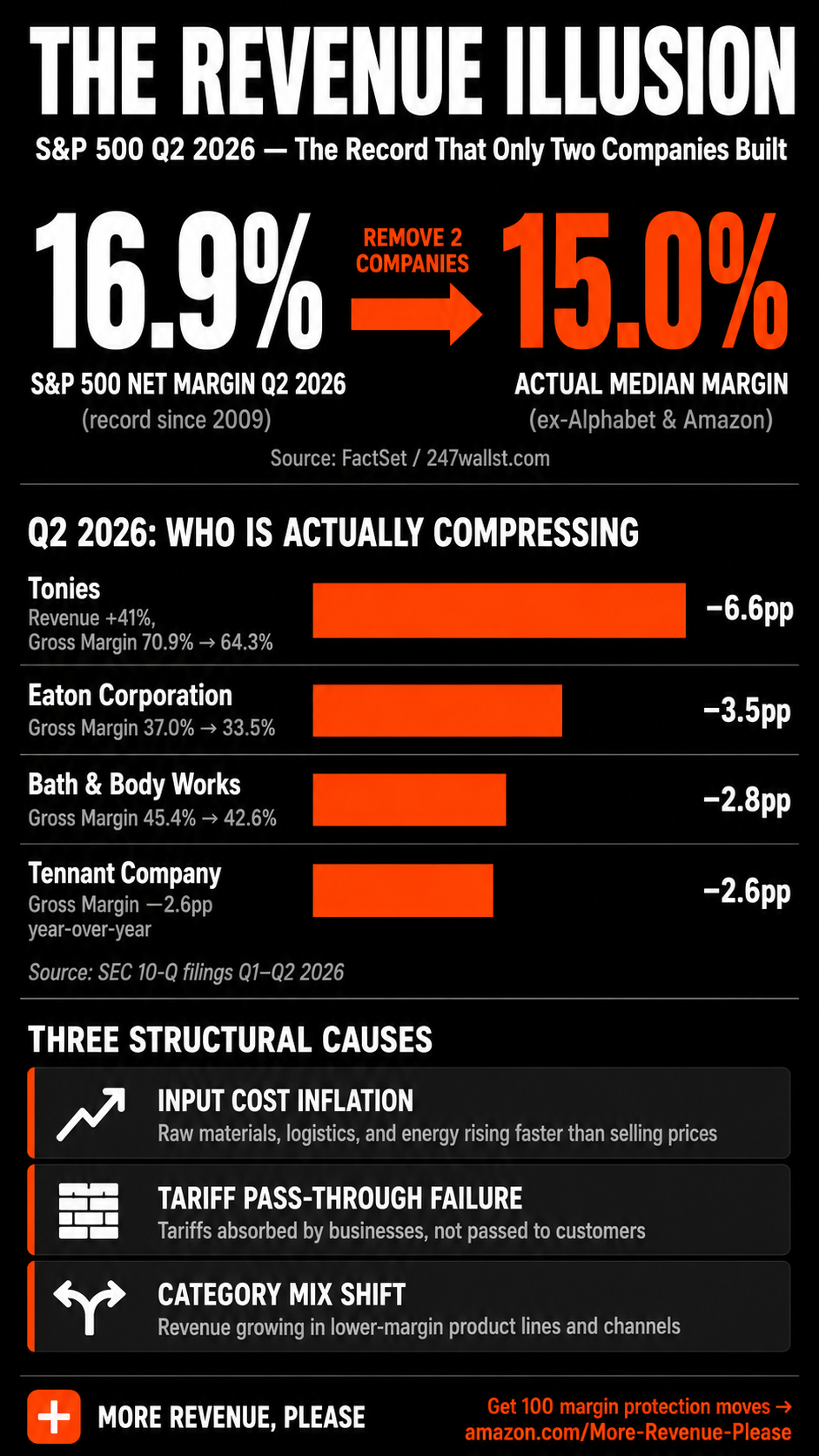
Q2 2026 delivered a headline that created misplaced confidence across the business community: the S&P 500 net profit margin reached 16.9%, the highest level recorded since FactSet began tracking this metric in 2009. A record profit margin at index level sounds like broad, healthy performance.
It is not.
Remove Alphabet and Amazon from the calculation. The net profit margin falls from 16.9% to 15.0% immediately. Two companies are responsible for the entire record. The remaining 498 companies in the index — and every CFO and founder outside of mega-cap technology — are not living in a record-margin environment. They are operating in a margin compression environment dressed up in a record-margin headline.
Most business leaders read that 16.9% figure and benchmark against it. They draw the wrong conclusion: margins are fine everywhere, therefore our situation is normal. Their situation is not normal. The headline is a statistical artifact of two companies with structural advantages — AI infrastructure scale, advertising network effects, and cost bases that most businesses cannot replicate — that have nothing to do with how other businesses are actually performing.
What Q2 2026 Earnings Actually Show
The real pattern in Q2 2026 earnings is consistent across sectors, company sizes, and geographies. Revenue is growing. Margin is not keeping pace.
Tonies SE, the consumer technology company, reported H1 2026 revenue of €243 million — a 41% increase in constant currency terms. Strong top-line growth by any measure. At the same time, gross margin fell from 70.9% to 64.3%, a contraction of 6.6 percentage points in a single half-year reporting period. Adjusted EBITDA margin compressed to 0.7% from 2.1% in the prior year. The revenue headline is impressive. The margin story is the one that matters for the health of the business.
Eaton Corporation, one of the largest industrial companies globally, reported Q2 2026 gross margin of 33.5%, down from 37.0% in the same period the year before — a 3.5 percentage point decline even as revenue continued to expand. Tennant Company saw gross margin fall by 260 basis points (2.6 percentage points) year-over-year. Bath & Body Works saw gross margin contract from 45.4% to 42.6% in Q1 2026, driven by tariff impacts, inflation, and a shift in product mix toward lower-margin categories.
Outside the US, the pattern holds. NAVER, South Korea's dominant technology company, reported revenue growth of 16% while operating profit stayed essentially flat and operating margin fell 2.5 percentage points as the company poured investment into AI infrastructure and commerce expansion. MercadoLibre reached a landmark $10 billion quarterly revenue milestone — and reported operating margin contraction of 550 basis points in the same quarter.
These are not struggling companies. Most of them are growing. The problem is the margin generated by that growth is shrinking — and the revenue number alone cannot show you that.
Three Structural Drivers Behind the Gap
Understanding what is causing the compression determines where action is possible.
The cost floor has moved — and most businesses have not fully repriced. Tariffs, commodity inflation, and wage pressure have permanently raised the cost base for most businesses. These costs sit directly in the cost of goods or cost of service, and they hit gross margin on delivery. Tonies specifically cited US tariff timing as a driver of margin compression. Bath & Body Works listed tariffs alongside broader inflation as primary causes of their gross margin contraction. The businesses that absorbed these cost increases without corresponding price increases are carrying the entire impact in their margin — and will continue to do so until they reprice or restructure costs.
The product and service mix is shifting toward lower-margin lines. Revenue can grow even when the mix of that revenue deteriorates. Tonies grew strongly through Toniebox hardware — a lower-margin product — rather than through its higher-margin content and subscription revenue. GCL Holdings reported revenue growth of 68% year-over-year, but gross margin fell from 15.0% to 10.3% because that growth came predominantly through lower-margin distribution business rather than higher-margin core operations. When the fastest-growing part of the business is also the lowest-margin part, the top line rises and the margin rate falls simultaneously.
Investment spending is outpacing the revenue it was built to produce. A meaningful share of the margin compression in Q2 2026 reflects deliberate investment decisions — spending on logistics, AI, market expansion, and integration that precedes the revenue it will eventually generate. MercadoLibre's 550 basis point operating margin contraction was driven by investment in logistics infrastructure, AI capabilities, and credit expansion. NAVER's flat operating profit reflects heavy investment in AI infrastructure ahead of the revenue that investment will produce. These may be sound long-term decisions. The near-term cost is being absorbed in margin, and the revenue growth headline conceals it from leaders who are not looking carefully.
The Compounding Risk of Revenue-Only Management
A revenue miss produces an immediate, visible signal. When revenue is down, no leader needs to be convinced there is a problem. Boards ask questions. Plans are revised. Action is taken.
Margin compression that happens alongside revenue growth produces no equivalent signal. The dashboard looks healthy. Quarterly reviews celebrate top-line performance. Leaders feel confident heading into the next period. The margin problem compounds quietly underneath every positive-looking revenue report.
There is a specific window between when margin compression begins and when it becomes visible in the P&L as a profitability problem. During that window, the structural causes — cost absorption, mix deterioration, investment overhang — become embedded in the operating model. The longer the window stays open, the harder and more disruptive the repair becomes.
The Q2 2026 earnings season is telling CFOs and founders that window is open right now. Revenue growth is masking a margin problem that, for most businesses, has been building since 2024 and is accelerating in 2026.
What CFOs and Founders Should Do Right Now
Each of these actions can begin this week.
1. Set a margin floor alongside every revenue target. Every revenue target should carry a minimum gross margin threshold. Revenue growth that falls below the margin floor triggers a structured review rather than a celebration. Define these floors before the next planning cycle. Without them, the revenue target creates incentives that can drive margin compression — more volume, lower prices, higher service costs — that the revenue number alone will never flag.
2. Run a product and service mix review. Pull revenue by product line or service category and calculate the gross margin contribution of each. Identify the fastest-growing lines. If the highest-growth lines carry below-average margins, the mix is shifting against the business even as the top line expands. This analysis typically takes one week and identifies where margin recovery is possible without reducing revenue.
3. Audit pricing against actual cost increases. Most businesses raised prices in 2022 and 2023 to address inflation and then paused. Input costs — tariffs, wages, materials, logistics — have continued rising. If prices have not moved since the last inflation-driven increase, the business is absorbing ongoing cost growth directly in gross margin. A targeted price audit identifies the specific lines where the gap is largest and repricing is most defensible.
4. Track cost-of-revenue growth rate against revenue growth rate monthly. If cost of revenue is growing faster than revenue, gross margin is compressing — regardless of what the absolute margin number looks like today. This ratio should be a standing metric reviewed in every management meeting, not a diagnostic triggered after a problem has already emerged.
5. Replace the S&P 500 as a margin benchmark. The Q2 2026 index margin is inflated by 1.9 percentage points from two companies. Benchmarking the health of your margin against that number will give you false confidence. Sector peers at similar scale, companies with comparable business models, and your own prior period performance are far more meaningful comparisons.
Revenue Tells You How Fast. Margin Tells You Whether You Arrive.
Revenue growth is real in Q2 2026. The businesses generating it are not getting weaker because they are growing. They are getting weaker because the margin generated by each unit of that revenue is shrinking — and most leaders are not tracking that signal closely enough to see it happening while there is still time to act.
The revenue number shows the speed of movement. The margin number shows whether that movement is building value or eroding it. In Q2 2026, those two signals are diverging across most of the economy. The earnings season is providing the data. The CFOs and founders who read it and act will be in a fundamentally stronger position than those who celebrated the revenue headline and moved on.
More Revenue, Please by Nader Sabry covers exactly how to protect and rebuild margin from inside the business — pricing discipline, discount control, renewal management, churn prevention, and cost structure review. One hundred ways to find, protect, and accelerate the revenue already inside the business you have.
Related reading: The Working Capital Trap and The Retention Illusion.
Sources
Tonies H1 2026 Revenue and Margin Report — Tonies SE / Investing.com — August 20, 2026 — https://www.investing.com/news/company-news/tonies-h1-2026-slides-41-revenue-growth-margin-pressure-weighs-93CH-4870091
S&P 500 Q2 2026 Earnings Insight — FactSet / 24/7 Wall St — July 27, 2026 — https://247wallst.com/investing/2026/07/27/the-sp-500-is-on-track-to-post-record-q2-profits-but-theres-a-catch/
Eaton Corp 10-Q FY2026 — SEC / Eaton Corp — Q2 2026 — https://www.sec.gov/Archives/edgar/data/0001551182/000155118226000030/etn-20260630.htm
Tennant Co 10-Q FY2026 — SEC / Tennant Co — Q2 2026 — https://www.sec.gov/Archives/edgar/data/0000097134/000009713426000024/tnc-20260630.htm
Bath & Body Works 10-Q FY2026 — SEC / Bath & Body Works — Q1 2026 — https://www.sec.gov/Archives/edgar/data/0000701985/000070198526000014/bbwi-20260502.htm
NAVER Q2 2026 Earnings Slides — NAVER / Investing.com — August 2026 — https://www.investing.com/news/company-news/naver-q2-2026-slides-revenue-climbs-16-as-ai-investments-pressure-margins-93CH-4845013
MercadoLibre Q2 2026 Earnings — MercadoLibre / Investing.com — August 5, 2026 — https://www.investing.com/news/company-news/mercadolibre-q2-2026-slides-10b-revenue-milestone-amid-margin-pressure-93CH-4839803
GCL Fiscal 2026 Earnings — GCL Holdings / TradingKey — 2026 — https://www.tradingkey.com/news/earnings/262075521-tradingkey