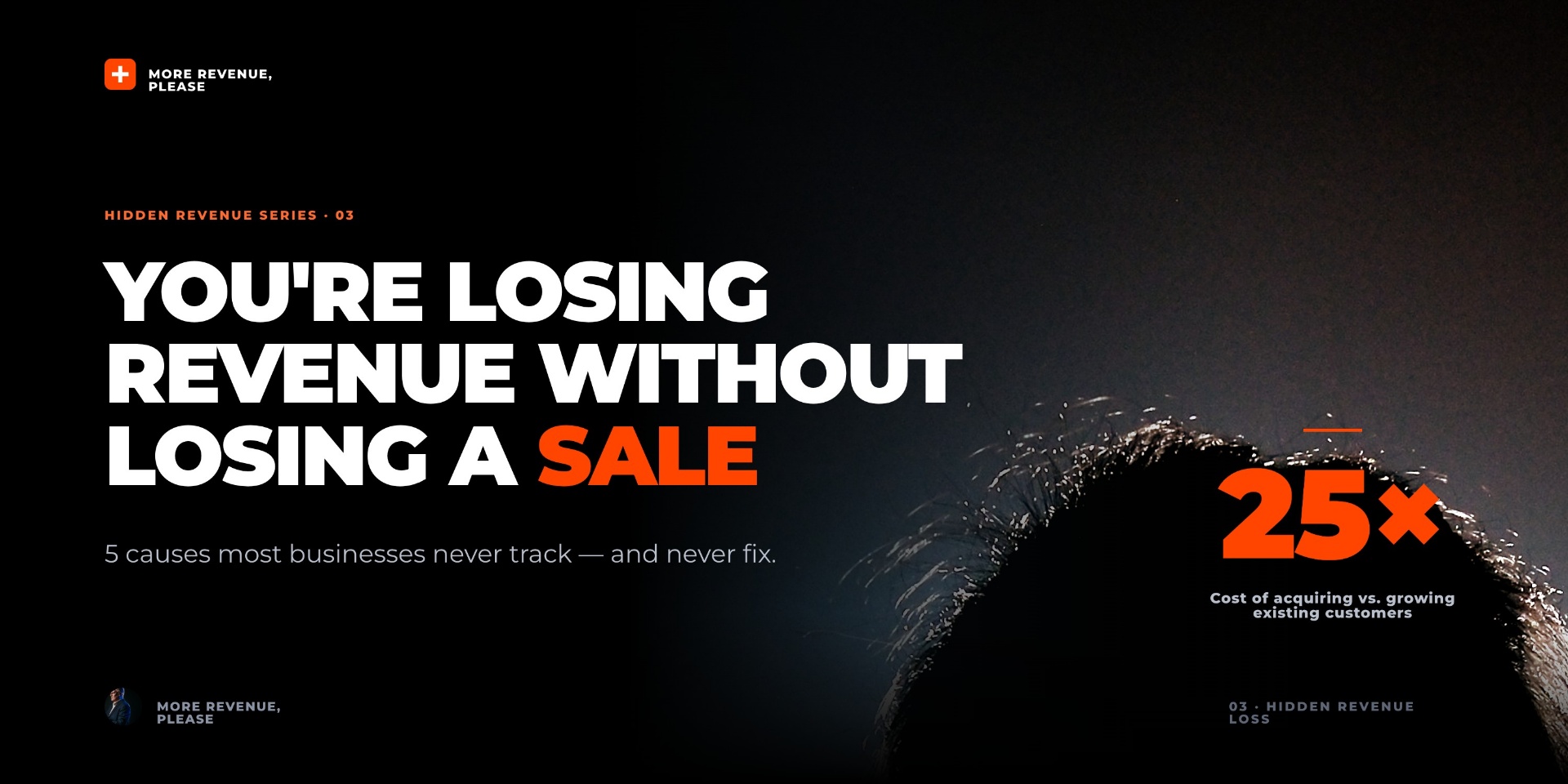
That Have Nothing to Do With Sales. Your sales team is hitting their targets. Your revenue still isn't where it should be. Here's why.
Here's a number that surprises most finance leaders when they first see it.
Harvard Business Review research shows that acquiring a new customer costs between 5 and 25 times more than retaining and growing an existing one. Yet most commercial strategies still allocate the majority of their budget, attention, and headcount to acquisition — while the revenue they've already earned quietly drains out through gaps nobody is formally tracking.
McKinsey data shows that companies with the strongest cross-sell and upsell execution see profits improve by 20–30%. Not from new market entry. Not from new product launches. From the customers already in the system.
The implication is significant: in most businesses, a material portion of the revenue problem has nothing to do with sales at all. Here are five of the most common causes.
1. Pricing Erosion Nobody Tracks
Pricing in most businesses isn't set once and held. It degrades — through discounts approved under pressure, legacy contracts never renegotiated, promotional rates that were supposed to be temporary but never rolled back, and rate cards that haven't been reviewed since the last time input costs changed.
One analysis of B2B billing practices found that up to 40% of accounts continue on expired promotional pricing because the billing system never applied the rollback. That's not a sales problem. That's a commercial governance problem — and it compounds silently every month. Research across CFOs puts the annual cost of this leakage at 3–9% of earned revenue — the gap between what contracts say you should be collecting and what actually arrives.
The revenue impact is invisible on the P&L because it never appears as a cost. It just appears as revenue that's lower than it should be, with no obvious label explaining why. When that erosion compounds across an entire business, the result is what Q2 2026 earnings revealed at scale: revenue growing while margin contracts — a business getting weaker as the headline number looks healthier.
2. Customers Ready to Spend More Who Never Get Asked
Expansion revenue is consistently underestimated as a growth lever. Real-world data demonstrates the disparity starkly: Rapid7's Q1 2024 results show $1.9 million in new customer revenue against $20 million from existing customers through renewals, upsells, and cross-sells. That ratio — roughly 10-to-1 in favour of existing customers — isn't unusual. It's the norm in most mature B2B businesses.
The failure here isn't that customers don't want to spend more. It's that nobody has a structured process for identifying who's ready to expand and what they're ready to buy. Cross-sell and upsell opportunities exist in almost every customer portfolio. They just require the same rigour that acquisition gets: a defined motion, clear ownership, and a plan that gets executed consistently.
3. Billing Friction Slowing Revenue You've Already Earned
Revenue that exists in a contract but hasn't been invoiced yet isn't revenue you've lost — but it isn't revenue you're benefiting from either. For most businesses this gap is larger than it appears — 59% of small businesses are carrying overdue invoices with an average of $17,700 in uncollected cash from work already completed. Delayed invoicing, manual billing cycles, milestone invoices that require chasing to trigger, payment terms longer than they need to be — each of these represents cash sitting outside the business longer than it should be.
Separately, involuntary churn from expired cards and failed payment processing accounts for up to 40% of total customer attrition in subscription businesses. Best-in-class recovery processes recapture 38% of failed payments; average processes recover only 15%. That gap is pure recoverable revenue requiring no new customers at all.
4. Undermonetised Assets Already in the Business
Most businesses accumulate assets that generate less revenue than they could — or none at all. Intellectual property that could be licensed, data assets that have commercial value, platforms built for internal use that could be offered to partners, relationships with distribution partners that are underutilised, capacity that sits idle outside peak periods.
The reason these assets go undermonetised isn't that the opportunity isn't there. It's that no one has been given explicit responsibility to find it. One structured review of what a business owns versus what it's monetising typically surfaces at least one or two significant opportunities — neither of which requires a new hire or a new product launch.
5. Churn Treated as a Sales Problem Instead of a Commercial One
When customers leave, most businesses respond by asking the sales team to replace them. That's an expensive instinct. Replacing a lost customer with a new one costs multiples of what retaining them would have — and the new customer typically takes months to reach the revenue level the churned customer represented.
The more productive question is why the customer left — and whether the cause is addressable before others follow the same path. Fixing billing-related involuntary churn alone is documented to lift annual revenue by 8.6% in year one. Sales-led retention is the last resort. Commercial-led retention is the prevention.
The Common Thread
In each of these five areas, the issue isn't what's being sold. It's how well the business is protecting, capturing, and growing the revenue it's already earned.
This is the distinction between a sales strategy and a commercial strategy — and it explains why most revenue problems are not sales problems. A sales strategy focuses on what goes in. A commercial strategy manages every stage of the revenue cycle — including the parts that happen after the deal is signed.
The businesses that consistently grow revenue without adding headcount or launching new products have a structured approach to all five of these areas — with a specific number committed to a specific time window, not a general intention to improve.
More Revenue, Please — 500+ Ways to Grow Revenue Within 60 Days is available now in paperback and hardcover.
Nader Sabry is a growth scientist, HBR Arabia contributor, and author of the Growth Science series.