Walmart and Target reported second-quarter earnings the same week. Same consumer pool. Same economic environment. Same tariff pressures. One beat. One missed.
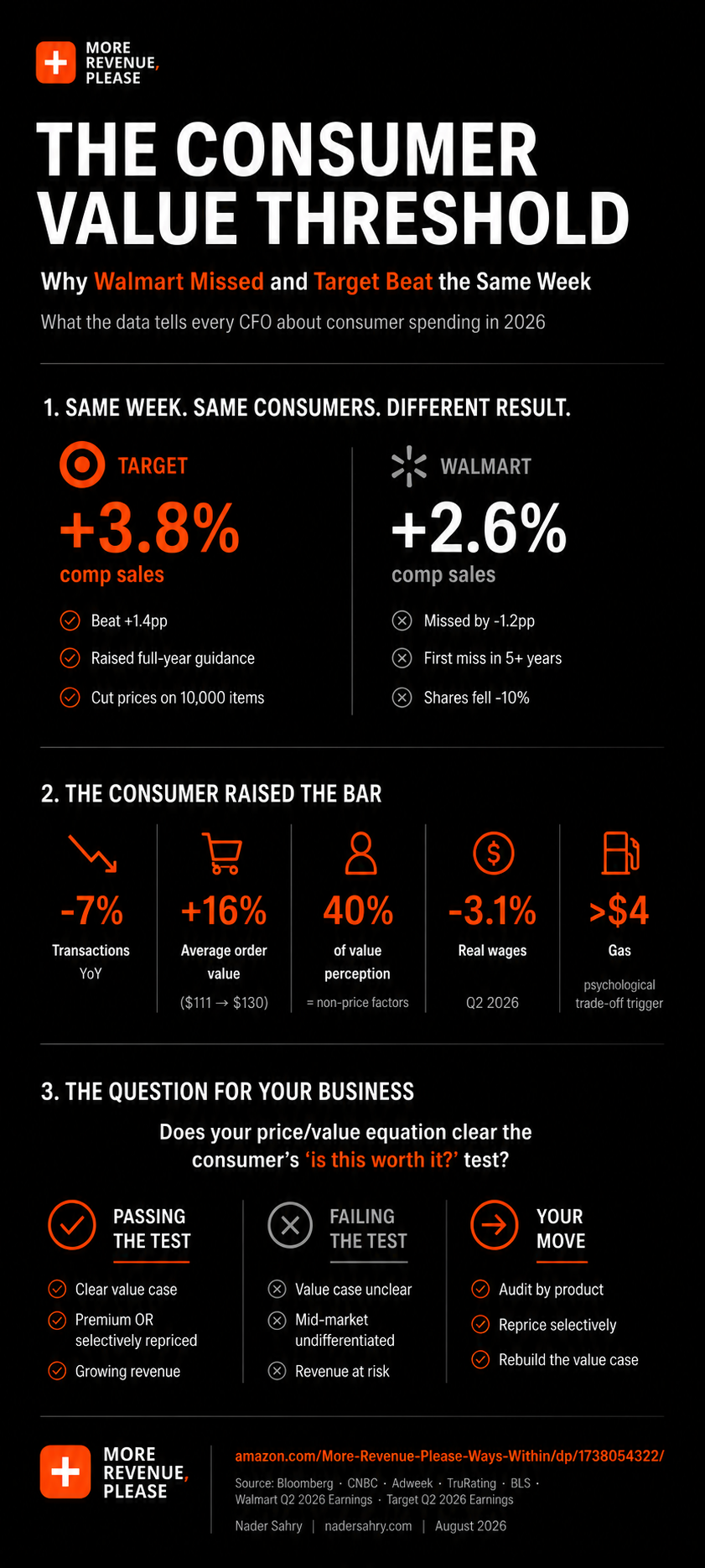
Walmart posted comparable sales growth of 2.6% — its first miss against analyst forecasts in more than five years. Shares fell 10%, the worst single-day drop since May 2022. Target posted comparable sales growth of 3.8%, beating the 2.4% forecast by a significant margin. The company raised its full-year guidance the same morning.
The difference was not foot traffic. It was not macroeconomics. It was not even tariff exposure — both companies face the same import cost environment.
The difference was whether the price/value equation passed the test consumers are now running at checkout.
Target passed. Walmart, this quarter, did not.
Bloomberg called it directly: "Walmart, Target Earnings Show US Consumers Still Buying for Right Price." That framing is precise. The consumer did not pull back from spending. They raised their standard for what spending requires. The businesses clearing that standard are capturing revenue. The ones that are not are watching it walk out the door.
What Actually Happened at Walmart — and Why It Matters
The Walmart miss is easy to misread. Walmart did not have a bad quarter. Revenue grew 3.4% overall. Earnings per share beat forecasts. The miss was specifically on comparable store sales — which measures whether existing customers are returning and spending more each visit than they did the year before.
They came back. They spent less than expected.
That distinction is important. A traffic problem would mean consumers are not showing up. A conversion problem would mean consumers are browsing but not buying. What Walmart reported was a third thing: consumers arrived, put something in the cart, reached checkout — and spent less than the prior year comparable. That is a value threshold problem. The consumer was present and willing. The price/value equation did not clear the bar.
Walmart's CFO named the specific pressure points on the earnings call. Gas prices above $4 per gallon created a psychological switching effect — when fuel costs cross that threshold, consumers begin actively trading off other spending categories. The pharmacy business saw revenue drop because the Inflation Reduction Act's Maximum Fair Price program lowered what consumers pay per prescription visit, reducing per-visit spend. And tariff-driven price increases across general merchandise created friction at the point of purchase decision.
None of these were demand collapses. They were each a version of the same signal: the consumer evaluated the value equation and adjusted. The Walmart quarter did not represent a consumer who stopped spending. It represented a consumer who got more selective about when spending feels justified.
What Target Did Differently — The 10,000 Item Playbook
Target's result was not luck. It was a specific strategic decision executed ahead of this earnings cycle.
Target lowered prices on more than 10,000 individual items across its stores, with more reductions still in the pipeline. The strategy was not a blanket price cut — it was a selective repricing of specific categories where consumer price sensitivity was identified as the friction point. By meeting the consumer at the threshold rather than asking them to come up to the old price, Target removed the hesitation moment that Walmart ran into.
The result: comparable sales grew 3.8% against a 2.4% expectation. Full-year guidance raised. Target stock held while Walmart fell 10%.
The mechanism is instructive. Target's 10,000 price cuts were not across the board. They were targeted at the specific items and categories where the value equation was most under pressure — where the gap between perceived value and current price was creating resistance. Premium categories at Target were largely left alone. The selective repricing sent a clear message: we know what you are sensitive to, and we are meeting you there.
This is not the same as simply cutting prices. It is understanding where the consumer's value threshold sits by product and category, and then making decisions selectively rather than uniformly. Businesses that cannot make that distinction end up either over-cutting margin on products where they had pricing power, or leaving friction in place on products where they did not.
The Consumer Value Threshold — What the Data Shows
The Walmart and Target results are not isolated. They reflect a consumer behaviour pattern that has been building in 2026 and that mid-year spending data had already flagged.
Adweek's mid-year 2026 consumer spending report found that transaction volumes fell 7% year over year, while average order value jumped 16% — from $111 to $130. Consumers are buying less often. But when they do buy, they are spending more per transaction. They are choosing deliberately, buying what feels worth it, and skipping what does not.
That pattern tells you something specific. The consumer is not financially exhausted. They have not stopped opening their wallets. They are running a tighter filter on what clears the value bar. The businesses that are growing — premium retailers like Williams-Sonoma and Ralph Lauren reported strong results the same period — are doing so because their products pass the filter. The "is this worth it?" question gets a clear yes.
Real household purchasing power is also genuinely compressed. Real hourly compensation fell 3.1% in Q2 2026 — the lowest reading since Q4 2022 [BLS]. That means consumers are managing tighter budgets while also running a higher value filter on their spending decisions. Those two things together produce exactly the behaviour the data shows: fewer transactions, but higher spend per transaction when the value case is clear.
TruRating's consumer research adds a layer that most pricing strategies miss: 40% of consumer value perception comes from factors other than price — quality, customer service, checkout experience, and loyalty programmes. The consumer's "right price" is not purely a number. It is a ratio: what they are getting versus what they are paying, across every dimension of the experience, not just the sticker.
Gas above $4 per gallon acts as a psychological amplifier. When fuel costs hit that threshold, consumers shift into trade-off mode across their entire spending basket. The Q3 personal consumption expenditure forecast from Bloomberg's survey of economists fell to 2.1% annualised — down from 3.2% in Q2. Consumer spending is slowing at the aggregate level. But within that slowdown, the businesses meeting the value threshold are growing. The ones not meeting it are contributing disproportionately to the aggregate decline.
The Premium Paradox — Why Expensive Products Are Still Selling
One of the more counterintuitive aspects of the 2026 consumer environment is the performance of premium retailers. Williams-Sonoma, Ralph Lauren, and similar brands are reporting strong results while mid-market retailers are struggling. On the surface, that looks backwards. If consumers are squeezed, shouldn't the expensive options be hurting most?
The answer is that the value threshold is not a price ceiling. It is a value test.
A $400 kitchen product from Williams-Sonoma passes the test if the consumer believes it is genuinely better, more durable, and worth the premium over a cheaper alternative. A $25 item at Walmart fails the test if the consumer is not convinced it delivers meaningfully more than the $18 version sitting next to it on the shelf.
The consumer in 2026 is not asking "is this cheap?" They are asking "is this worth it?" Those are fundamentally different questions, and most pricing strategies are built to answer the first one. The businesses that are growing understand they need to answer the second.
This also explains the polarisation happening in retail. The high end is holding because luxury and premium consumers still have budget and the value perception is clear. The value end is holding for basics and essentials where the purchase is non-discretionary. The middle — mid-market products that are not cheap enough to be automatic purchases and not differentiated enough to be clearly worth a premium — is the squeeze zone. That is where Walmart's miss was most visible.
What the Consumer Value Threshold Means for Your Revenue
The Walmart and Target results are the clearest live data point available for what happens when businesses are on either side of the consumer value threshold. The question for every CFO and founder reading this is simple: which side is your business on right now?
Most businesses do not know. They have a price, they have a product, and they have revenue that is trending in some direction — but they have not mapped where their offer sits relative to the consumer's current value test. The Walmart result suggests that even companies with enormous scale, sophisticated pricing teams, and global logistics can get that mapping wrong in a single quarter.
The businesses that are most exposed right now are those in the middle of the market — not obviously cheap, not obviously premium — with prices that have risen through the tariff and inflation cycle without a corresponding strengthening of the value proposition. The consumer sees a price that has moved up, a product or experience that has not meaningfully changed, and runs the "is this worth it?" calculation. Many are concluding it is not.
The businesses that are best positioned are those that have either held the value case for their price point clearly (premium) or actively repriced specific products to meet the consumer threshold (Target). Both of those are active decisions. Neither happened by accident. Related reading: The Volume Trap — Why Fewer Transactions Can Mean More Revenue and Your Revenue Is Up. Your Business Is Getting Weaker.
Six Moves to Unlock Consumer Revenue at the Right Price
The consumer value threshold is not a problem that goes away when macroeconomic conditions improve. The data on average order value — up 16% even as transaction volume fell 7% — suggests the consumer has permanently elevated their standards for what earns a purchase. The businesses that calibrate to it now build durable revenue positioning. Those that wait for conditions to ease will find the threshold has not lowered.
1. Audit your price/value position by product, not portfolio. The same logic that caught Walmart applies at any scale. A portfolio average misses the specific products where the gap between price and perceived value has opened. Map your product range by category and ask: where is the consumer likely to run the "is this worth it?" test and conclude it is not? Those are your highest-risk revenue lines right now.
2. Identify what is driving value perception in your category. TruRating found that 40% of consumer value perception comes from non-price factors: quality signals, service quality, checkout or onboarding experience, and loyalty or relationship recognition. Before cutting prices, understand whether the value case can be strengthened through the non-price components first. Sometimes a better experience at the same price point moves the consumer's calculation without touching the margin.
3. Make selective price moves, not uniform ones. Target did not cut prices on everything. They cut prices on 10,000 specific items where consumer price sensitivity was creating friction. The discipline of selectivity is important — it protects margin on products where the value case is already holding while removing resistance where it is not. A uniform price cut destroys margin on products where you had pricing power and may not even solve the problem where you did not.
4. Test the threshold before committing broadly. The Walmart miss happened at scale across a full quarter. You can test the value threshold at much lower cost through limited price moves, product bundle tests, or added-value pilots in specific channels or segments. The data from a limited test is more valuable than an assumption built on last year's price architecture.
5. Address the non-discretionary triggers that create trade-off mode. Walmart's CFO specifically named gas above $4 as a psychological switching trigger — when fuel crosses that threshold, consumers actively trade off across their entire spending basket. If you sell anything that sits in the discretionary half of a consumer's budget, understand what the macro triggers are that push your customers into trade-off mode. Those triggers are your leading indicator of when the value threshold tightens further.
6. Rebuild the value case before the next price move. If prices have risen through the tariff and inflation cycle without a corresponding investment in the value proposition — product quality, service, experience, loyalty — the current consumer will notice. The businesses unlocking consumer revenue in 2026 are not just repricing. They are rebuilding what the price delivers. That is a harder conversation internally, but it is the one that produces durable results rather than a temporary relief that erodes again in the next quarter.
Recent Developments — Sources Behind This Story
The following credible sources provide the earnings data, consumer research, and economic context behind this analysis.
Earnings — The Walmart/Target Divergence:
— Bloomberg: Walmart, Target Earnings Show US Consumers Still Buying for Right Price (August 20, 2026 — the clearest single headline framing the consumer value threshold)
— Al Jazeera: Walmart Sees Sales Drop as US Consumer Spending Retreats (August 20, 2026 — Walmart comparable sales miss, share price decline detail)
— CNBC: Target Q2 2026 Earnings Beat (August 19, 2026 — comparable sales +3.8%, guidance raised)
— Quartz: Target Q2 2026 — Sales Beat, Full-Year Guidance Raised (August 19, 2026 — Target strategy and performance detail)
— 24/7 Wall St: Three Cracks in Consumer Spending Reveal Why Walmart Had Its Worst Day Since 2022 (August 24, 2026 — gas prices, pharmacy IRA caps, tariff friction breakdown)
— CPA Practice Advisor: Retail Earnings Show U.S. Consumers Keep Spending for the Right Price (August 25, 2026 — cross-sector earnings synthesis, published yesterday)
Consumer Data — Spending Behaviour:
— Adweek: 2026 Mid-Year Consumer Spending — Inflation Driving Fewer Purchases, Higher Value Orders (2026 — transactions -7%, average order value +16%, $111 to $130)
— Forbes: How Retailers Can Navigate 2026 Now That Price Has Become the Deciding Factor (March 2026 — structural analysis of price as the deciding factor in consumer decisions)
— CFO Brew: Target, Walmart Earnings Reports Tell Different Stories About Consumer Spend (August 2026 — CFO-lens analysis of the two divergent results)
The Revenue Question Behind the Earnings Story
The Walmart and Target results are the earnings story of the week. But the revenue question they raise applies well beyond retail.
Any business whose revenue runs through consumer spending — directly as a retailer or service provider, or indirectly as a supplier to consumer-facing businesses — is now operating in an environment where the consumer's value test is tighter and more explicit than it was in 2024. The macro conditions that created it — tariff-driven price increases across categories, real wage compression, gas above $4, a post-pandemic normalisation of spending discipline — are not going away in the next quarter.
The consumer who arrived at Walmart's checkout and spent less than expected did not leave disappointed with Walmart specifically. They left after making a value calculation that did not clear the bar. If your product or service is in their spending basket, you need to know whether your price/value equation clears that bar — because the consumer is running the test regardless of whether you are.
Target ran the test ahead of time, identified the specific items where the gap was widest, and closed it. The result was a 3.8% comparable sales beat and raised guidance. That is what finding the threshold and meeting it looks like in practice.
More Revenue, Please provides the framework for identifying where your revenue is locked behind a value case that has not been made — and what to do about it. The consumer value threshold is the 2026 version of the question the book was written to answer: